



Allele

Key Concepts
- Genetic Inheritance
- Genes
- Chromosomes
- Alleles
- Genotype Alleles
Recall
- DNA structure
- Chromosomes
- Genes
Chromosomes are thread-like structures present within the cells of living organisms. Chromosomes consist of DNA and protein. Genes are a series of nucleotides; they are regarded as a unit of heredity, responsible for passing characteristics and traits from the parent to children. The genes are constrained within the chromosomes, which lie in the nucleus of the cells. The chromosomes are made up of thousands and thousands of genes.

Introduction:
An allele is an important term in genetics. Gene is a structural unit of chromosome; genes carry heredity from one generation to another. The alleles are pairs of genes located in a specific area of the chromosome. Let us discuss the meaning of alleles.
Explanation:
Definition- alleles are a pair of genes that occupy a location on a chromosome and control the same trait.
In the human chromosome, alleles are present in pairs and maintain the same trait. Therefore, humans are diploid organisms. Two similar alleles are present in the genetic locus, where one allele is inherited from each parent. An allele can be two or more variants of a gene at one genetic locus.

Meaning of Alleles
The word allele comes from the Greek word ‘allos’. The word ‘allos’ means other. An allele means various varieties of a gene. The alleles present in a genetic locus maintain the same trait. However, alleles are present in a locus as a set or pair, they can be found in more than two numbers. In the human chromosome, alleles are present in a pair only to carry the heredity.

Genotype of Allele
Alleles are present in a particular location of a chromosome. The chromosome is the central part of an organism. Alleles are present in an organism that builds genotype. Genotype is of two types depending on the similarities of the alleles.
When the pair of alleles are the same, it is a homozygous genotype. When the pair of alleles in a location are not the same, it is a heterozygous genotype. In the homozygous genotype, the allele is not dominant or recessive. But the heterozygous genotype includes one dominant allele. The dominant allele rules the features of the recessive allele.

Example of Alleles
Example of a pea plant. The alleles showing the color of the flower build heterozygous genotype, the purple allele is dominant, and the white is recessive. The height of a plant, tall is a dominant allele, and short is recessive. The pea plant flower color, the dominant allele is yellow, and the recessive allele is green. In these cases, the dominant alleles overrule the recessive alleles in the case of heterozygous genotype. The eye color and hair color of human organisms can be observed as an example of alleles.

Multiple Alleles
Alleles or allelomorphs are the alternative forms of a gene present in the same location on the homologous chromosomes. Genes have more than two allelic forms, which are referred to as multiple alleles.
Multiple Alleles Examples
Blood Groups in Humans
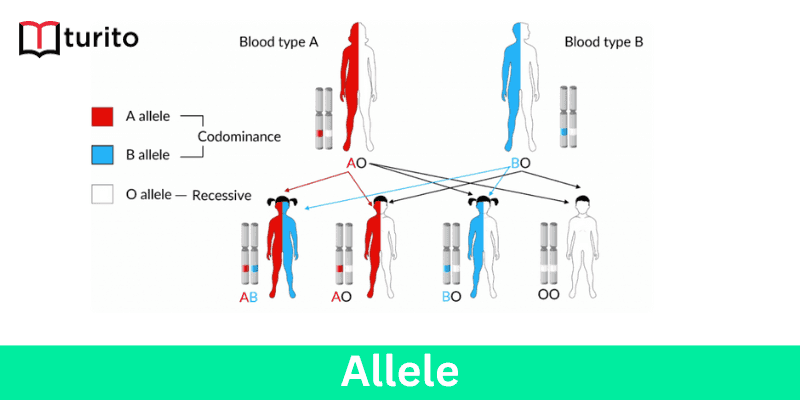
The A, B, AB, and O blood groups are the types in humans that are determined by three alleles of a gene. Gene I, which determines the blood type, is present in three allelic forms. They are IA, IB and i. The allele IA makes surface antigen A on the red blood cells, the allele IB makes the surface antigen B on the red blood cells and the allele i has no antigen. Allele IA and IB are codominant over allele i.
A person has any of the two alleles out of the three alleles on the homologous chromosomes. If a person has two IA alleles (IAIA) or one IA and one i allele (IAi) then the person’s blood group is the ‘A’ group. Likewise, IBIB and IBi give rise to blood group type ‘B.’ IAIB gives rise to AB blood group, and two i alleles (ii) give rise to ‘O’ blood group.

Related topics
Types of Ecosystem and its Functions
What is an Ecosystem? As a term, the word ecosystem was first used by English botanist Arthur Tansley in 1935. It is understood as a dynamic bubble of living organisms in a non-living environment and includes the changing exchanges between both parties. Living organisms, in this definition, refer to plants, animals, microbes, and similar biotic […]
Mutation Theory of Evolution and Types
Introduction: Cell is the basic unit of living organisms from bacteria to humans all are made up of cells, which contain a nucleus and the nucleus contain DNA Explanation: Mutations is a sudden changes in chromosomal DNA., They cover only those changes that alter the chemical structure of the gene at the molecular level. These […]
Lamarckism: Postulates and Drawbacks
Introduction: Evolution states that distinct types of plants, animals, and other living organisms on Earth have their origin in pre-existing life forms. It is a variation in the inherited characteristics (traits) of biological populations over successive generations. These traits are the expressions of genes that are passed on from parents to offspring in the course […]
Biodiversity: Classification of Living Organisms
Introduction to Biodiversity: Fig No.1 Biodiversity Classification Fig No.2 Different organisms The Characteristics of Living Organisms Fig No. 3 Classification Diversity in Living Organisms The Five Kingdom Classification The five kingdoms in this widely accepted classification are made up of species with similar growth and functioning characteristics. Organisms are classified into five kingdoms based on […]


Other topics



Comments: