



Factors for Plants Growth: Sunlight and Photosynthesis

Key Concepts
- Water affecting plants
- Water absorbed by plants
- Transpiration
- Photosynthesis
Introduction:
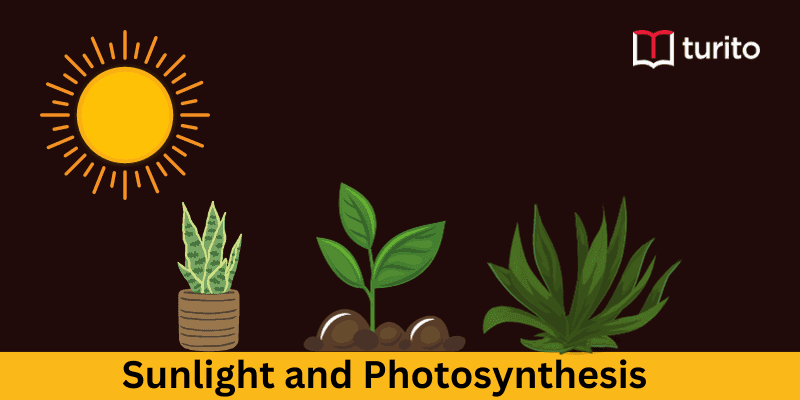
Plants get their energy from the sun. Plants cannot eat food like us. They use solar energy to make their food. Plants make a sugar called glucose.
Without the sun, plants cannot get the food they need to grow, reproduce, and survive.
Explanation:

The sun’s light energy provides the much-needed nutrients to plants that help in the growth of plants. The light from the sun is an important part of stimulating the growth of any plant, be it in the desert or forest.
Needs of a Plant
All the plants require space to grow, the right temperature, light, water, air, and nutrients. These factors affect the growth of the plant most.


Space: Both the roots and leaves need space to grow. The leaves need space so the sunlight can get to them, and the roots need space to absorb water and nutrients.

Temperature: All the plants need the right temperature at the right time in their life cycle to grow.
Light: Photosynthesis is the process through which plants convert solar energy into energy that they can use.
Water: Water carries essential nutrients from the soil to the plant tissues.
Air: Plants need air to make food.
Nutrients: Plants need nutrients to grow, germinate, fight off pests, and reproduce.

Importance of light for plants
Let’s perform an experiment to check if plants really do need light.
- Take two potted plants.
- Tape foil over all the leaves of one of the potted plants.
- Place both plants in a sunny location and water them when needed.
- After a week, remove the aluminum foil from the leaves.

What will you observe?
You will observe that the plant not covered with foil paper looks healthy, whereas the covered plant looks wilted because plants need sunlight to survive.

Just like we need to stay warm, plants need a warm temperature. Light keeps plants warm and helps make food for the plants through photosynthesis.
Photosynthesis
Plants don’t eat food as humans and animals do. They get their energy from the sun.
The word photosynthesis is separated into two smaller words, “Photo” and “Synthesis.”

The process by which green plants use sunlight to make their own food is called photosynthesis.
It is necessary for plants. Without this process, there would be no green plants, and without green plants, there would be no animals.
This process takes place in the leaves of plants.
Photosynthesis requires water, sunlight, and carbon dioxide gas.

During photosynthesis, green plants use the sun’s energy to change water and carbon dioxide into a sugar called glucose.
Plants use glucose for energy.
Do you know about carbon dioxide and glucose?
Carbon dioxide is a gas that plant takes from the atmosphere mainly through their leaves.
Glucose is a sugar that plants use as food to help them stay alive and grow.

Summary:
- The plant needs sunlight to grow.
- Plants get their energy from the sun.
- All the plants require space to grow, the right temperature, light, water, air, and nutrients.
- Green plants use sunlight to make their food, and this process is called photosynthesis.
- Without photosynthesis, there would be no green plants, and without plants, there would be no animals.
- The process of photosynthesis takes place in the leaves of a plant.
Related topics
Types of Ecosystem and its Functions
What is an Ecosystem? As a term, the word ecosystem was first used by English botanist Arthur Tansley in 1935. It is understood as a dynamic bubble of living organisms in a non-living environment and includes the changing exchanges between both parties. Living organisms, in this definition, refer to plants, animals, microbes, and similar biotic […]
Mutation Theory of Evolution and Types
Introduction: Cell is the basic unit of living organisms from bacteria to humans all are made up of cells, which contain a nucleus and the nucleus contain DNA Explanation: Mutations is a sudden changes in chromosomal DNA., They cover only those changes that alter the chemical structure of the gene at the molecular level. These […]
Lamarckism: Postulates and Drawbacks
Introduction: Evolution states that distinct types of plants, animals, and other living organisms on Earth have their origin in pre-existing life forms. It is a variation in the inherited characteristics (traits) of biological populations over successive generations. These traits are the expressions of genes that are passed on from parents to offspring in the course […]
Biodiversity: Classification of Living Organisms
Introduction to Biodiversity: Fig No.1 Biodiversity Classification Fig No.2 Different organisms The Characteristics of Living Organisms Fig No. 3 Classification Diversity in Living Organisms The Five Kingdom Classification The five kingdoms in this widely accepted classification are made up of species with similar growth and functioning characteristics. Organisms are classified into five kingdoms based on […]


Other topics





Comments: