



Active and Passive Voice

Voice, it is also known as diathesis, is a grammatical feature that describes the relationship between the subject in a sentence and the verb.
Active Voice
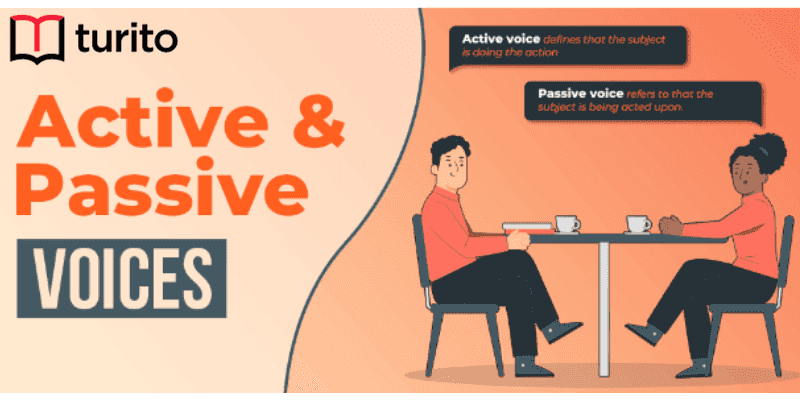
When the subject of a sentence is the doer or actor, the verb is in the active voice. It is so because the subject is active.
- I see the Academy Awards ceremony every year.
- Do you know the winners’ names?
Passive Voice
In passive-voice sentences, the subject is the receiver of the action.
A passive-voice verb is utilized in the past participle form preceded by the auxiliary verb “be.”
- The Academy Awards ceremony is seen by millions.
- The winners’ names are not known until the night of the ceremony.
General rules of Voice Change:
- The object of the action word in the active voice will be the subject of the action word in the aloof voice.
- The subject of the action word in the active voice will be the object in the passive voice. (Generally preceded by the preposition “by”)
- The main verb is transformed into the past participle form, and it is preceded by the correct form of the verb ‘to be ‘in passive voice.
- There are some verbs with the objects. In such cases, either of the objects can be changed into the subject, and other is retained as an object. The objects are called retained objects.
Use of Passive Voice:
- When the receiver of the action is essential: To emphasize the importance of the receiver of the action.
- When articulating a professional, neutral, or objective tone: To articulate a neutral, professional, or objective tone.
- Generally, the receiver of the action functions as the primary topic throughout the text.
- It is used when the agent is unknown, irrelevant, or implied.
- It is used while softening an authoritative tone.

Related topics

Informational Text – Features, Types with Examples
What is an Information Text? Any piece of writing falls under the category of fiction or non-fiction. Fiction is a work of imagination (made up story), whereas non-fiction is based on facts and actual events or real people. Informational texts are non-fiction works that inform the readers about a specific topic. They are found in […]

Figurative Language : Types and Examples
Figurative Language What is Figurative Language? A language that describes something by comparing it with something else, you are using figurative language. Types of Figurative Language: Imagery The Language that appeals to the senses. Descriptions of people or objects are stated in terms of our senses. Simile It includes a straight comparison between two unlike things, […]

Types and Uses of Punctuation Marks with Examples
Imagine reading a story with no full stops, no commas, and no question marks! You will not be able to understand what it meant. It would feel messy and hard to follow. That is where punctuation marks come in. They help organise our thoughts and make writing easier to read. They show pauses, expressions, and […]
Naming Words for Class 2: Simple English Guide
Naming words are names of people, animals, birds, places or things. E.g. Leo, Rat, Crow, London, Book Four types of naming words E.g. Leo, Andrea, Father, Mother E.g. School, London, Park, New york E.g. Tiger, Monkey, Cow, Parrots E.g. Box, Pen, Apples, Car Everything that we can touch, feel, see and talk about is represented by […]


Other topics



Comments: