



Adages and Proverbs

Proverbs
- Proverb is a short, well-known saying stating a piece of advice or the general truth.
- It can be described as a statement of practical wisdom expressed in a simple way.
- It is based on common sense or a person’s practical experience. Proverbs are typically metaphorical or alliterative in form.
Examples
- Slow and steady wins the race.
- Birds of a feather flock together.
- Rolling stones gather no moss.
- It is better to be smarter than you appear than to appear smarter than you are.
- Don’t count your chickens before they hatch.
- Those who live in glass houses shouldn’t throw stones.
Adages
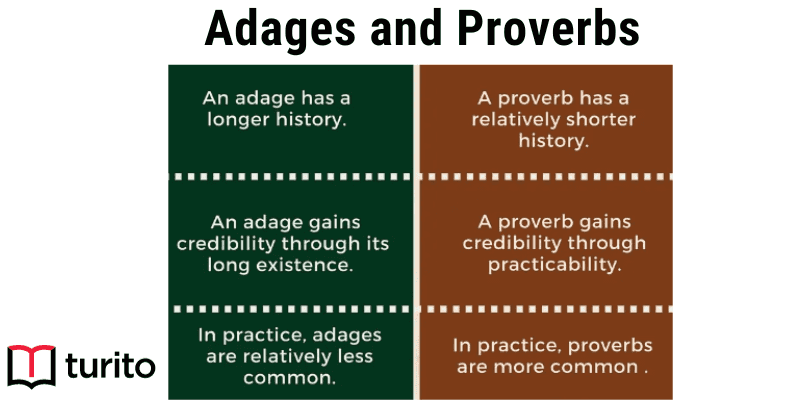
- It is a short, common saying or phrase that tends to be old, known for decades or centuries.
- It refers to popular sayings that give advice.
- It expresses a general truth about people or the world.
- It could be based on facts. It can also come from a specific situation or job.
- It is similar to a proverb and proverbs could be adages.
Examples
- A penny saved is a penny earned .
- Slow and steady wins the race.
- Better safe than sorry.
- Little strokes fell great oaks.
- Nothing ventured; nothing gained.
- You live, you learn.
- All roads lead to Rome.
- Love is blind.
- Where there’s smoke, there’s fire.
Keep in mind
- An adage is sometimes called proverb.
- They are usually smaller than proverbs.
- So don’t worry about mixing both up, as they have mostly similar qualities.

Related topics

Informational Text – Features, Types with Examples
What is an Information Text? Any piece of writing falls under the category of fiction or non-fiction. Fiction is a work of imagination (made up story), whereas non-fiction is based on facts and actual events or real people. Informational texts are non-fiction works that inform the readers about a specific topic. They are found in […]

Figurative Language : Types and Examples
Figurative Language What is Figurative Language? A language that describes something by comparing it with something else, you are using figurative language. Types of Figurative Language: Imagery The Language that appeals to the senses. Descriptions of people or objects are stated in terms of our senses. Simile It includes a straight comparison between two unlike things, […]

Types and Uses of Punctuation Marks with Examples
Imagine reading a story with no full stops, no commas, and no question marks! You will not be able to understand what it meant. It would feel messy and hard to follow. That is where punctuation marks come in. They help organise our thoughts and make writing easier to read. They show pauses, expressions, and […]
Naming Words for Class 2: Simple English Guide
Naming words are names of people, animals, birds, places or things. E.g. Leo, Rat, Crow, London, Book Four types of naming words E.g. Leo, Andrea, Father, Mother E.g. School, London, Park, New york E.g. Tiger, Monkey, Cow, Parrots E.g. Box, Pen, Apples, Car Everything that we can touch, feel, see and talk about is represented by […]


Other topics





Comments: