



Learn Adverbs – Grade 6 English | Types, Examples & Exercises

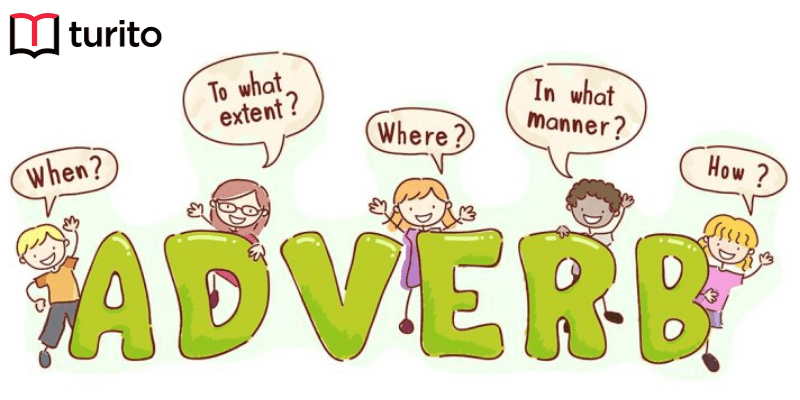
Adverbs often tell when, where, why or under what conditions something happens or the frequency at which action happens.
Examples:
- She arrived late.
- The box is still below the stairs.
- He drove too slowly.
Types of Adverb
- Adverbs of manner
- Adverbs of place
- Adverbs of degree
- Adverbs of frequency
- Adverbs of time
- Adverb of purpose
- Adverbs of affirmation and negation
Adverb of Manner:
An adverb of Manner tells how or in what manner an action is done.
Examples:
- He looked nervously round the room.
- She listened politely.
Adverb of Place:
Adverb of place shows the place where the action takes place.

Examples:
- Today I lost my pen somewhere.
- Where is my school diary?
Adverb of degree:
An adverb of degree shows the degree of the action of its verb.
Examples:
- It is somewhat hot in here.
- He completely changed my career.
Adverb of frequency:
An adverb of number/frequency shows how often or how many times
an action takes place.
Examples:
- He is often late for work.
- I occasionally eat junk food.
Adverb of time :
Adverb of time shows the time when the action take place.
Examples:
- I have been running for three hours.
- I will see you later.
Adverb of Purpose:
An adverb of reason or cause shows the reason why the action is taken.
Examples:
Because I was sick, I stayed home.
She leaves her office early, so that he could help his child with homework.
Adverbs of affirmation and negation:
Which says yes if it is yes and no if it is no.
Examples:
We are definitely leaving tomorrow.
I have never seen him.
Related topics

Informational Text – Features, Types with Examples
What is an Information Text? Any piece of writing falls under the category of fiction or non-fiction. Fiction is a work of imagination (made up story), whereas non-fiction is based on facts and actual events or real people. Informational texts are non-fiction works that inform the readers about a specific topic. They are found in […]

Figurative Language : Types and Examples
Figurative Language What is Figurative Language? A language that describes something by comparing it with something else, you are using figurative language. Types of Figurative Language: Imagery The Language that appeals to the senses. Descriptions of people or objects are stated in terms of our senses. Simile It includes a straight comparison between two unlike things, […]

Types and Uses of Punctuation Marks with Examples
Imagine reading a story with no full stops, no commas, and no question marks! You will not be able to understand what it meant. It would feel messy and hard to follow. That is where punctuation marks come in. They help organise our thoughts and make writing easier to read. They show pauses, expressions, and […]
Naming Words for Class 2: Simple English Guide
Naming words are names of people, animals, birds, places or things. E.g. Leo, Rat, Crow, London, Book Four types of naming words E.g. Leo, Andrea, Father, Mother E.g. School, London, Park, New york E.g. Tiger, Monkey, Cow, Parrots E.g. Box, Pen, Apples, Car Everything that we can touch, feel, see and talk about is represented by […]


Other topics



Comments: