



Articles – Uses and its Types

Use of a, an, the
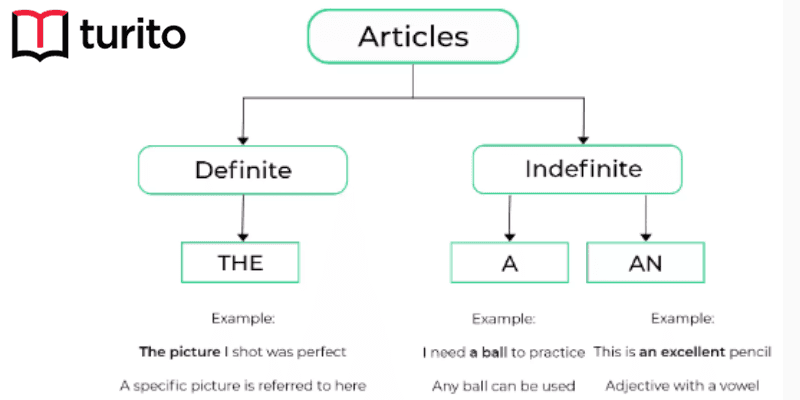
A, an, and the are known as articles. They are used to point out nouns and define a noun as specific or unspecific.
Articles modify or describe nouns.
The two types of articles in English are definite article and indefinite article.
The definite article
The definite article is ‘the.’ We use ‘the’ to denote specific nouns. Article ‘the’ is used when we talk about a thing which we have already mentioned.
‘The’ is used for singular or plural nouns.

For example: The puppy is brown in color. (We have already talked about the puppy.)
‘The’ is also used when a thing is only one of its kind.
For example: The sun, the moon, the Statue of Liberty
The indefinite article
The indefinite article has two forms- ‘a’ and ‘an.’ They indicate nouns that are not specific.
‘A’ and ‘an’ are used to introduce singular nouns. They are used to denote nouns which are mentioned for the first time.
For example: Jeff has a puppy. (It can be any puppy.)
She ate an apple.
‘A’ is preceded by a word that begins with a consonant.
For example: a goat, a plate, a European (‘European’ starts with a consonant sound)
‘An’ is preceded by a word that begins with a vowel sound. Vowels are a, e, i, o, u.
For example: an apple, an umbrella.
No articles
In some cases, no articles are used. This is when we talk about something in general or when we mention a city or country or with superlatives.
For example: I love movies.
I visited Switzerland last year.
Using a or an – Exceptional case
We usually use “a” before consonants and “an” before vowel sounds. There are exceptions to this.
When a word begins with a consonant, but sounds like a vowel, itis preceded by ‘an.’
For example: The school program will start in an hour.
When a word’s first letter is a vowel, but is pronounced as a consonant, it is preceded by ‘a.’
For example: Mike is a European.
Related topics

Informational Text – Features, Types with Examples
What is an Information Text? Any piece of writing falls under the category of fiction or non-fiction. Fiction is a work of imagination (made up story), whereas non-fiction is based on facts and actual events or real people. Informational texts are non-fiction works that inform the readers about a specific topic. They are found in […]

Figurative Language : Types and Examples
Figurative Language What is Figurative Language? A language that describes something by comparing it with something else, you are using figurative language. Types of Figurative Language: Imagery The Language that appeals to the senses. Descriptions of people or objects are stated in terms of our senses. Simile It includes a straight comparison between two unlike things, […]

Types and Uses of Punctuation Marks with Examples
Imagine reading a story with no full stops, no commas, and no question marks! You will not be able to understand what it meant. It would feel messy and hard to follow. That is where punctuation marks come in. They help organise our thoughts and make writing easier to read. They show pauses, expressions, and […]
Naming Words for Class 2: Simple English Guide
Naming words are names of people, animals, birds, places or things. E.g. Leo, Rat, Crow, London, Book Four types of naming words E.g. Leo, Andrea, Father, Mother E.g. School, London, Park, New york E.g. Tiger, Monkey, Cow, Parrots E.g. Box, Pen, Apples, Car Everything that we can touch, feel, see and talk about is represented by […]


Other topics



Comments: