



Colons and Semi Colons

Using Colons and Semi Colons
Semi-colon
It is a punctuation mark that is used to separate two independent (main) clauses which are closely related to each other.
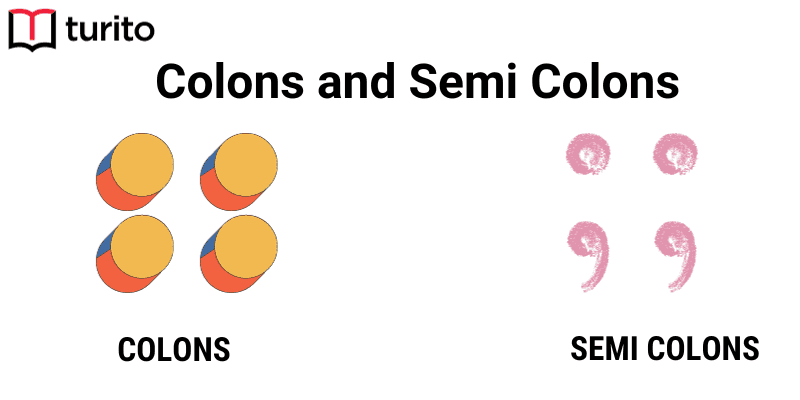
It looks like a period/full stop on top of a comma.
It is stronger than a comma but weaker than a period.
It takes the place of the conjunction within the sentence.
If there is more than one clause in a sentence, use a semicolon to replace the coordinating conjunction (but, and, or, nor, for, so, yet, etc.)

- It was hot and the sun was glaring.
- It was hot; the sun was glaring.
- I love to dance and my mother loves to sing .
- I love to dance; my mother loves to sing.
- The shop was closed because everyone was on leave.
- The shop was closed; everyone was on leave.
Other Uses
To separate items within a list.
- I want the following: moisturizer for the skin, some hair gel and mascara.
It can be used in place of a comma, especially in a list already containing commas
- The crew will consist of Jonathan, the geologist; Marie, the archeologist; Sean, the botanist.
It’s also used between independent clauses which are joined by conjunctive adverbs (like however, moreover, thus and therefore.) Put a comma after the conjunctive adverb.
Colon
It is a punctuation mark
It looks like two dots, one on top of the other:
It can be used to introduce what follows it
- We will need many things for our trip: a tent, clothes, blankets and a towel.
It can introduce a word, phrase, sentence, quotation, or a list.
It emphasizes what we’re introducing. So, it makes the reader stop and pay attention to what follows the colon.
- The school provided the following food during the war: beans, bacon, milk and flour.
It can be used to separate two independent but linked clauses.
The second clause concludes the first clause and also adds more detail to it.
- An alligator is not an amphibian: it is a reptile.
- Everyone agreed: the alligator is a reptile.
In some cases, colons are also used to introduce a quotation or direct speech.
For example:
- Mother told me: “Think before you leap.”
Related topics

Informational Text – Features, Types with Examples
What is an Information Text? Any piece of writing falls under the category of fiction or non-fiction. Fiction is a work of imagination (made up story), whereas non-fiction is based on facts and actual events or real people. Informational texts are non-fiction works that inform the readers about a specific topic. They are found in […]

Figurative Language : Types and Examples
Figurative Language What is Figurative Language? A language that describes something by comparing it with something else, you are using figurative language. Types of Figurative Language: Imagery The Language that appeals to the senses. Descriptions of people or objects are stated in terms of our senses. Simile It includes a straight comparison between two unlike things, […]

Types and Uses of Punctuation Marks with Examples
Imagine reading a story with no full stops, no commas, and no question marks! You will not be able to understand what it meant. It would feel messy and hard to follow. That is where punctuation marks come in. They help organise our thoughts and make writing easier to read. They show pauses, expressions, and […]
Naming Words for Class 2: Simple English Guide
Naming words are names of people, animals, birds, places or things. E.g. Leo, Rat, Crow, London, Book Four types of naming words E.g. Leo, Andrea, Father, Mother E.g. School, London, Park, New york E.g. Tiger, Monkey, Cow, Parrots E.g. Box, Pen, Apples, Car Everything that we can touch, feel, see and talk about is represented by […]


Other topics



Comments: