



Colons and Semi-Colons

Semicolon
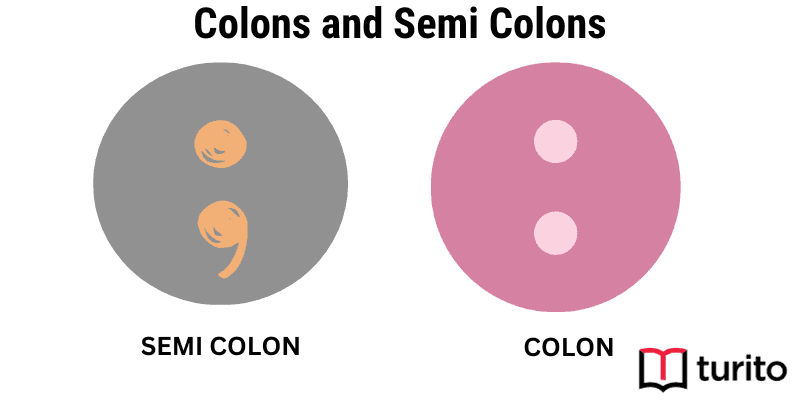
To put it in a simple way, a semicolon is a period stacked on top of a comma (;). But that is only its appearance. The semicolon is most commonly used to join two independent clauses without the use of a conjunction such as ‘and’.
Note: Semicolons cannot be used in place of commas or periods. Instead, they’re somewhere in the middle: let’s say more powerful than a comma but not as divisive as a period.
It is mandatory for the words preceding the semicolon to form a complete sentence. Likewise, the words following the semicolon should also form a complete sentence, so that the two sentences share a close, logical connection, like:
- We are playing football; John is playing for us.
- He is an excellent, talented musician; he will soon compose music for movies.
- Money cannot buy you happiness; it can help you lead a luxurious life.
A semicolon is also used to part a series of loosely related clauses, like:
- “Her court was pure; her life serene;”
- “God gave her peace; her life reposed.”
Moreover, nevertheless, however, otherwise, therefore, then, finally, likewise, and consequently are called conjunctive adverbs. When the second sentence begins with either a conjunctive adverb or a conjunction, a semicolon should be used instead of a period, like:

- I am going out to take a walk; also, I need to get some bread.
- Frank prepared day in, day out for the match; nevertheless, he couldn’t score any goals.
Colon
The punctuation mark that separates the two parts in each of the given sentences above is called a colon.
Read the following sentence:
I read all types of books: fiction, non-fiction, poetry, etc.
This sentence can be rephrased without using the colon and it will read like, “I read all types of books like fiction, non-fiction, poetry, etc.” Here, the colon is not used, because it may interrupt the flow of the sentence, which it gained with the addition of the word ‘like’.
Consider a colon to be a flashing arrow pointing to the information that follows it. When a colon is visible in a sentence, it usually implies, as follows, which is/are, or thus, like;
- The movie is a blend of different genres: fantasy, thriller, crime, etc.
- Most of my cousins live in other countries: England, Canada, and Germany.
- My father cooks good food: pasta, soups, cakes.
The colons used in these sentences indicate that the reader is about to know about the various things that are collectively mentioned in the first part of each of the sentences.
Just like a semicolon, a colon is also used to separate two independent clauses within a sentence. But here:
- The second clause should not be in any vague connection with the first one; it must be direct and closely connected to the first one in some sense.
- Also, the main emphasis should be on the second clause, not on the first one.
Examples:
- The decision is final: we are leaving this city.
- His academic performance is average: there is still room for improvement.
Related topics

Informational Text – Features, Types with Examples
What is an Information Text? Any piece of writing falls under the category of fiction or non-fiction. Fiction is a work of imagination (made up story), whereas non-fiction is based on facts and actual events or real people. Informational texts are non-fiction works that inform the readers about a specific topic. They are found in […]

Figurative Language : Types and Examples
Figurative Language What is Figurative Language? A language that describes something by comparing it with something else, you are using figurative language. Types of Figurative Language: Imagery The Language that appeals to the senses. Descriptions of people or objects are stated in terms of our senses. Simile It includes a straight comparison between two unlike things, […]

Types and Uses of Punctuation Marks with Examples
Imagine reading a story with no full stops, no commas, and no question marks! You will not be able to understand what it meant. It would feel messy and hard to follow. That is where punctuation marks come in. They help organise our thoughts and make writing easier to read. They show pauses, expressions, and […]
Naming Words for Class 2: Simple English Guide
Naming words are names of people, animals, birds, places or things. E.g. Leo, Rat, Crow, London, Book Four types of naming words E.g. Leo, Andrea, Father, Mother E.g. School, London, Park, New york E.g. Tiger, Monkey, Cow, Parrots E.g. Box, Pen, Apples, Car Everything that we can touch, feel, see and talk about is represented by […]


Other topics



Comments: