



Dashes and Parentheses

Read the following sentences:
- NASA (National Aeronautics and Space Administration)was established in 1958.
- Thomas was extremely talented- the most brilliant of students I have ever met.
In the above sentences, there is an extra layer of information/detailing about the subject that is being talked about. But here, the punctuation mark used in both sentences is not a comma.
In sentence 1, we could have easily done away with the expansion of the acronym NASA. The addition of the National Aeronautics and Space Administration can be seen as a passing comment because its absence wouldn’t have made much difference to the sentence. The brackets in the sentence are called parentheses.
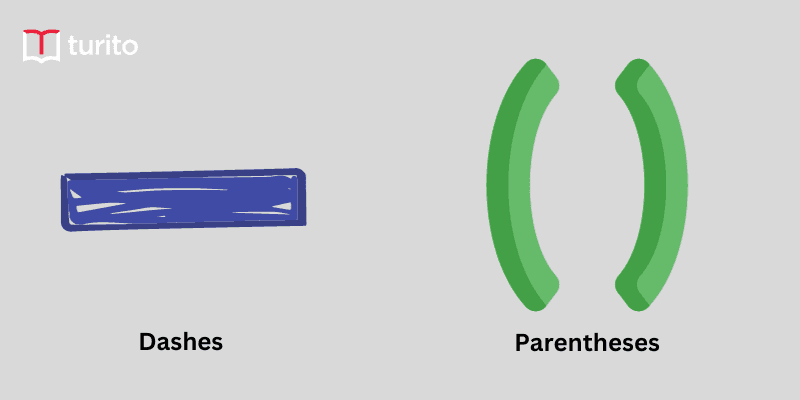
In sentence 2, the main sentence is slightly interrupted so that it makes way for the phrase that follows the punctuation mark used. Here, the additional phrase serves to grab the attention of the reader to the subject Thomas. The punctuation mark used in the sentence is called a dash.
Parentheses:
Parentheses are a pair of signs () that can be used to separate a phrase or a clause that does not grammatically belong to the main part of a sentence. They are used to set off information within a sentence and are capable of enclosing a single word, a phrase, or even an entire sentence. The words inside the parentheses usually provide additional information about something else in the sentence.
Examples:
- Some of the committee members (Mr. Swann and Mr. Smith, for example) raised objection to the proposal.
- The lunch that I had (the delicious, healthy salad) cost me $27.
- Max Dillon (the best written character in The Amazing Spiderman 2) gets an underwhelming conclusion in Spiderman: No Way Home.
According to many modern grammarians, the usage of parenthesis has started to dwindle. In fact, the Associated Press style guide would prefer that we stop using parentheses altogether, as it is jarring to the reader.

Dash:
A dash is a small horizontal line that appears in the center of a line of text. It is frequently used to denote an abrupt stop or a change of thought. If the sentence that precedes the interruption is to be continued, a pair of dashes should be used.
Examples:
- Had we prepared well- but let’s focus on the present.
- I met his parents- both of them- who are very disappointed with his exam results.
- Joshua drove the car faster- he wanted to reach the hospital as soon as possible.
PS: Dashes are generally used in casual texts and are more common in fiction writing. They are not used very frequently in formal writing.
Related topics

Informational Text – Features, Types with Examples
What is an Information Text? Any piece of writing falls under the category of fiction or non-fiction. Fiction is a work of imagination (made up story), whereas non-fiction is based on facts and actual events or real people. Informational texts are non-fiction works that inform the readers about a specific topic. They are found in […]

Figurative Language : Types and Examples
Figurative Language What is Figurative Language? A language that describes something by comparing it with something else, you are using figurative language. Types of Figurative Language: Imagery The Language that appeals to the senses. Descriptions of people or objects are stated in terms of our senses. Simile It includes a straight comparison between two unlike things, […]

Types and Uses of Punctuation Marks with Examples
Imagine reading a story with no full stops, no commas, and no question marks! You will not be able to understand what it meant. It would feel messy and hard to follow. That is where punctuation marks come in. They help organise our thoughts and make writing easier to read. They show pauses, expressions, and […]
Naming Words for Class 2: Simple English Guide
Naming words are names of people, animals, birds, places or things. E.g. Leo, Rat, Crow, London, Book Four types of naming words E.g. Leo, Andrea, Father, Mother E.g. School, London, Park, New york E.g. Tiger, Monkey, Cow, Parrots E.g. Box, Pen, Apples, Car Everything that we can touch, feel, see and talk about is represented by […]


Other topics





Comments: