



Personal Reflexive: Meaning and Example

Grammar – Pronouns – Types – Personal Reflexive
Personal Pronouns
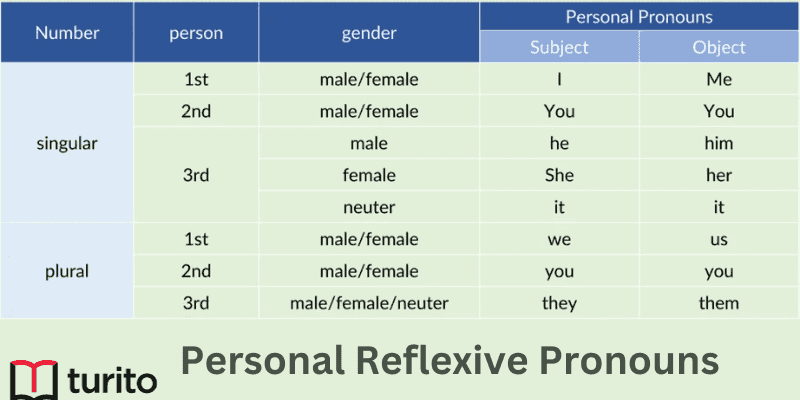
I, we, you, they are called personal pronouns because they stand for the three persons.
- First-person- I, we, me, us, mine, ours are the first person.
- Second person- You, yours are second person.
- Third person- He, she, it, they, him are third person.
Slide-9

Slide-10
Examples of Personal Pronouns
I like green tea / Sam helped me.

Do you like green tea? / Sam loves you.
She runs fast. / Did Tom beat him?
He is clever. / Does Mark know her?
We went to Church. / Robin drove us.
Do you need a table for four?/ Did James and Shelly beat you at doubles?
They played doubles. / James and Shelly beat them.
Slide-11
Sometimes we refer to a person, or an animal as She /her, and he/him. If the animal is a pet.
This is our dog Roby. He‘s a Pomeranian.
The Titanic was a remarkable ship, but she sank on her first voyage.
My first vehicle was a Mini and I treated her like my wife.
Slide-12
Examples for the first person
If a student needs help, he or she should
approach the teacher.
If a student needs help, he should approach the teacher.
If a student needs help, they should approach the teacher.
Slide-13
We generally use “It” to introduce a remark:
It is good to have a gala time sometimes.
It is important to take care.
It is difficult to find a place to live.
Is it normal to see them together in class?
It didn’t take long to stay here.
Slide-14
We often use it to talk about the weather, temperature, time and distance:
It is windy.
It will probably be foggy tomorrow.
Is it ten o’clock yet?
It is 80 kilometers from here to California.
Slide-15
A personal reflexive pronoun is a pronoun used as an object that cites to the same person or thing as the subject for, e.g., from the sentence given above:
She looked at herself in the mirror, here herself is the reflexive pronoun as it cites to the person as the subject, i.e., she is herself.
Slide-16
The commonly used reflexive pronouns are listed below:
myself: me (the speaker)
yourself: you as a singular (single person the speaker)
itself: it (a thing or an animal)
himself: him (a masculine)
herself: her (a feminine)
ourselves: us (the speaker and others together)
yourselves: you as a plural (the speaker)
Related topics

Informational Text – Features, Types with Examples
What is an Information Text? Any piece of writing falls under the category of fiction or non-fiction. Fiction is a work of imagination (made up story), whereas non-fiction is based on facts and actual events or real people. Informational texts are non-fiction works that inform the readers about a specific topic. They are found in […]

Figurative Language : Types and Examples
Figurative Language What is Figurative Language? A language that describes something by comparing it with something else, you are using figurative language. Types of Figurative Language: Imagery The Language that appeals to the senses. Descriptions of people or objects are stated in terms of our senses. Simile It includes a straight comparison between two unlike things, […]

Types and Uses of Punctuation Marks with Examples
Imagine reading a story with no full stops, no commas, and no question marks! You will not be able to understand what it meant. It would feel messy and hard to follow. That is where punctuation marks come in. They help organise our thoughts and make writing easier to read. They show pauses, expressions, and […]
Naming Words for Class 2: Simple English Guide
Naming words are names of people, animals, birds, places or things. E.g. Leo, Rat, Crow, London, Book Four types of naming words E.g. Leo, Andrea, Father, Mother E.g. School, London, Park, New york E.g. Tiger, Monkey, Cow, Parrots E.g. Box, Pen, Apples, Car Everything that we can touch, feel, see and talk about is represented by […]


Other topics



Comments: