



Phrases vs Clauses

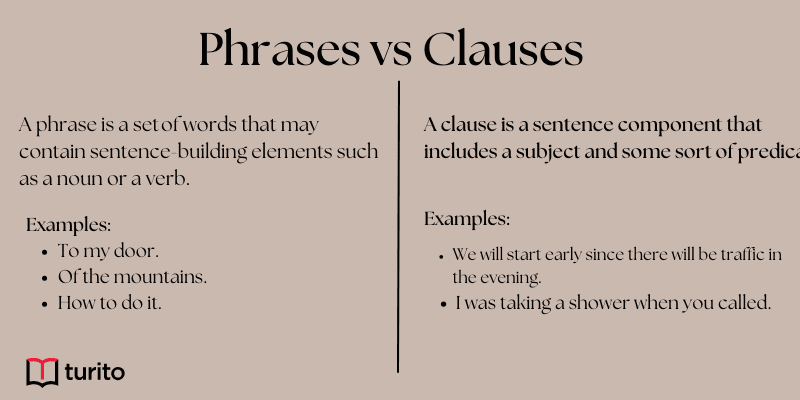
A phrase is a set of words that may contain sentence-building elements such as a noun or a verb.
Examples:
- To my door.
- Of the mountains.
- How to do it.
We know that a sentence is a group of words, which is complete in itself and makes complete sense and that it typically contains a subject and predicate.
But what do we call the group of words that themselves contain a subject and some kind of predicate within a sentence?
They are called clauses.

A clause is a sentence component that includes a subject and some sort of predicate.
Examples:
- We will start early since there will be traffic in the evening.
- I was taking a shower when you called.
Clauses are of two types: Dependent clauses and independent clauses.
Let us take a look at the different types of clauses and see how a clause is different from a phrase:
CLAUSES
1. Independent Clauses
An independent clause, also known as the main clause is a group of words that includes a subject and a predicate that can express a complete thought. An independent clause is capable of standing alone as a sentence.
Examples:
- He came back home in the evening.
- I won’t be able to get this done on time.
- I will be in Germany next week.
2. Dependent Clauses
Read the sentence:
You can call me when you are free.
In this sentence, the main clause is You can call me, which is a complete idea and can also stand to own its own as a sentence. But the group of words that follow-when you are free– acts as a subordinate to the main clause. Though they contain a complete idea within themselves, including a subject and corresponding predicate, the presence of the conjunction when indicates that the clause cannot stand alone as a sentence. It is determined by the main clause.
Now let us define a dependent clause:
A dependent clause is a group of words that has a subject and a predicate but does not express a complete thought. A dependent clause is incapable of standing alone as a sentence as it always needs a main clause to depend upon. Conjunction is frequently used to identify a dependent clause.
In fact, in many cases, the presence of a conjunction is the only thing that distinguishes an independent clause from a dependent clause.
Examples:
- Since the exams is beginning tomorrow, I must sleep earlier tonight.
- The crowd went berserk when their team scored a goal.
- Kelly eats fried food whenever she is away from home.
PHRASES
As explained earlier, a phrase is a set of words that may contain sentence-building elements such as a noun or a verb. It differs from a clause in that it may not include a subject or a predicate. A phrase adds meaning to a sentence by supplying more details regarding the subject, object, verb, or situation. A sentence is also made up of phrases, however, if you isolate a phrase from a sentence, it will not function as a whole sentence. To put it simply, clauses contain phrases, and sentences contain clauses.
Examples of phrases:
- The sun rises in the east.
- Humpty Dumpty sat on a wall.
- Tell me how to do it.
Related topics

Informational Text – Features, Types with Examples
What is an Information Text? Any piece of writing falls under the category of fiction or non-fiction. Fiction is a work of imagination (made up story), whereas non-fiction is based on facts and actual events or real people. Informational texts are non-fiction works that inform the readers about a specific topic. They are found in […]

Figurative Language : Types and Examples
Figurative Language What is Figurative Language? A language that describes something by comparing it with something else, you are using figurative language. Types of Figurative Language: Imagery The Language that appeals to the senses. Descriptions of people or objects are stated in terms of our senses. Simile It includes a straight comparison between two unlike things, […]

Types and Uses of Punctuation Marks with Examples
Imagine reading a story with no full stops, no commas, and no question marks! You will not be able to understand what it meant. It would feel messy and hard to follow. That is where punctuation marks come in. They help organise our thoughts and make writing easier to read. They show pauses, expressions, and […]
Naming Words for Class 2: Simple English Guide
Naming words are names of people, animals, birds, places or things. E.g. Leo, Rat, Crow, London, Book Four types of naming words E.g. Leo, Andrea, Father, Mother E.g. School, London, Park, New york E.g. Tiger, Monkey, Cow, Parrots E.g. Box, Pen, Apples, Car Everything that we can touch, feel, see and talk about is represented by […]


Other topics



Comments: