



Plot

The plot is a literary device used by writers to organize what happens in a story.
It is the sequence of events that make up a story.
Conflict is the essence of fiction. It creates a plot.
The dramatic conflict between two forces in a story. Without conflict, there is no plot.
Elements of Plots:
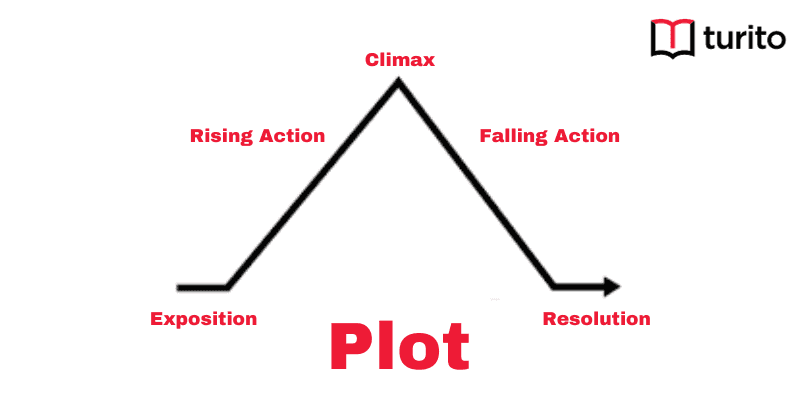
Exposition: At the start of the story, characters, setting, and the main conflict are typically introduced.

Rising Action: The main character is in disaster, and events leading to facing the conflict begin to open out. The story looks complicated.
Climax: At the climax of the story, a major event occurs in which the main character faces a major enemy, fear, challenge, or another source of conflict. The most action, drama, change, and excitement occur here.
Falling Action: The story starts to slow down and work towards its end, tying up loose ends.
Resolution: It is also termed as the denouement; the resolution is like a concluding paragraph that resolves any remaining issues and ends the story.
Related topics

Informational Text – Features, Types with Examples
What is an Information Text? Any piece of writing falls under the category of fiction or non-fiction. Fiction is a work of imagination (made up story), whereas non-fiction is based on facts and actual events or real people. Informational texts are non-fiction works that inform the readers about a specific topic. They are found in […]

Figurative Language : Types and Examples
Figurative Language What is Figurative Language? A language that describes something by comparing it with something else, you are using figurative language. Types of Figurative Language: Imagery The Language that appeals to the senses. Descriptions of people or objects are stated in terms of our senses. Simile It includes a straight comparison between two unlike things, […]

Types and Uses of Punctuation Marks with Examples
Imagine reading a story with no full stops, no commas, and no question marks! You will not be able to understand what it meant. It would feel messy and hard to follow. That is where punctuation marks come in. They help organise our thoughts and make writing easier to read. They show pauses, expressions, and […]
Naming Words for Class 2: Simple English Guide
Naming words are names of people, animals, birds, places or things. E.g. Leo, Rat, Crow, London, Book Four types of naming words E.g. Leo, Andrea, Father, Mother E.g. School, London, Park, New york E.g. Tiger, Monkey, Cow, Parrots E.g. Box, Pen, Apples, Car Everything that we can touch, feel, see and talk about is represented by […]


Other topics



Comments: