



Simple Guide to Plural Nouns for Grade 6 Students

Read the following pairs of sentences:
- My book is missing.
My books are missing. - The shop is open.
The shops are open. - The box is full.
The boxes are full.
Plural Nouns for Grade 6 Students
The change in form of the noun in second sentences of each pair.
The nouns in the first sentences of each pair denote one thing, and the nouns in the second sentences of each pair denote more than one thing.
A noun referring to a single person or thing is said to be in Singular Number, like;
Boy, girl, bird, book, tree, car, etc.
A noun referring to more than one person or thing, is said to be in Plural Number, like;

Boys, girls, birds, books, trees, cares, etc.
But there are certain things, let’s say rules, to keep in mind while forming the plural nouns from their singular counterparts.
Let us learn the rules
Rule 1:
Most nouns generally take their plural form by adding -s to the singular, like;
- Boy, boys
- Girl, girls
- Book, books
- Pen, pens
- Car, cars
Rule 2:
Nouns ending in -s, -sh, -ch, or -x and most nouns ending in -o usually form their plural by adding -es to the singular, like;
- Class, classes
- Kiss, kisses
- Watch, watches
- Dish, dishes
- Box, boxes
- Tax, taxes
- Buffalo, buffaloes
- Mango, mangoes
- Potato, potatoes
- Hero, heroes
- Cargo, cargoes
Rule 3:
There are a few nouns ending in -o that form plural merely by adding -s to the singular, like;
- Piano, pianos
- Dynamo, dynamos
- Kilo, kilos
- Photo, photos
- Commando, commandos
Rule 4:
Nouns ending in -y, when preceded by a consonant, form their plural by changing -y into -i and adding -es, like ;
- Lady, ladies
- Baby, babies
- Army, armies
- Story, stories
- City, cities
Rule 5:
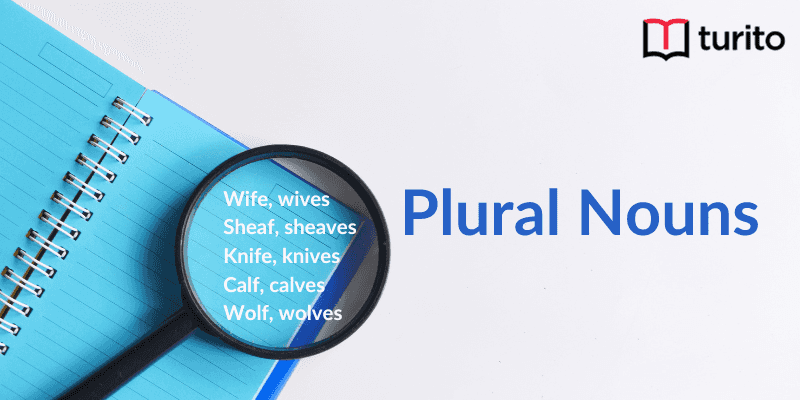
There are nouns ending in -f or -fe that form their plural by changing -f or -fe into v and adding -es. They are;
- Thief, thieves
- Life, lives
- Half, halves
- Loaf, loaves
- Wife, wives
- Sheaf, sheaves
- Knife, knives
- Calf, calves
- Wolf, wolves
- Elf, elves
- Shelf, shelves
- Leaf, leaves
- Self, selves
But nouns like scarf, dwarf, hoof, and wharf take either -s or -ves in the plural;
- Dwarfs or dwarves
- Scarfs or scarves
- Wharfs or wharves
- Hoofs or hooves
Most other words ending in -f or -fe take their plural form by adding -s, like;
- Chief, chiefs
- Gulf, gulfs
- Safe, safes
- Cliff, cliffs
- Proof, proofs
- Handkerchief, handkerchiefs
Rule 6:
There are a few nouns that change the inside vowel of the singular to form their plural, like;
- Man, men
- Goose, geese
- Mouse, mice
- Woman, women
- Foot, feet
- Tooth, teeth
Rule 7:
A few nouns form their plural by adding -en to the singular, like;
- Ox, oxen
- Child, children
Rule 8:
There are some nouns that have their singular and their plurals alike, like;
Swine, sheep, deer, luggage, aircraft, furniture, trout, salmon, series, species, spacecraft, etc.
Rule 9:
Some nouns are always used only in the plural:
- Names of instruments that have two parts forming a kind of pair, like;
Bellows, scissors, spectacles, etc.
- Names of certain articles of dress, like;
Jeans, trousers, drawers, shorts, etc.
Rule 10:
Certain collective nouns, though they are singular in form, are always used as plurals, like;
Poultry, cattle, vermin, people, gentry.
Rule 11:
Compound nouns generally form their plurals by adding -s to the principal word, like;
- Son-in-law – Sons-in law
- Commander-in-chief – Commanders-in-chief
- Looker-on – Lookers-on
- Stepson – Stepsons
- Passer-by – Passers-by
Related topics

Informational Text – Features, Types with Examples
What is an Information Text? Any piece of writing falls under the category of fiction or non-fiction. Fiction is a work of imagination (made up story), whereas non-fiction is based on facts and actual events or real people. Informational texts are non-fiction works that inform the readers about a specific topic. They are found in […]

Figurative Language : Types and Examples
Figurative Language What is Figurative Language? A language that describes something by comparing it with something else, you are using figurative language. Types of Figurative Language: Imagery The Language that appeals to the senses. Descriptions of people or objects are stated in terms of our senses. Simile It includes a straight comparison between two unlike things, […]

Types and Uses of Punctuation Marks with Examples
Imagine reading a story with no full stops, no commas, and no question marks! You will not be able to understand what it meant. It would feel messy and hard to follow. That is where punctuation marks come in. They help organise our thoughts and make writing easier to read. They show pauses, expressions, and […]
Naming Words for Class 2: Simple English Guide
Naming words are names of people, animals, birds, places or things. E.g. Leo, Rat, Crow, London, Book Four types of naming words E.g. Leo, Andrea, Father, Mother E.g. School, London, Park, New york E.g. Tiger, Monkey, Cow, Parrots E.g. Box, Pen, Apples, Car Everything that we can touch, feel, see and talk about is represented by […]


Other topics



Comments: