



Point Of View – Concept and Its Types

Point of view
The narrative voice through which you convey a story is called point of view. When you’re writing a story, you must figure out who’s telling it and to whom they’re saying it.
There are three types of points of view:
- First person
- Second person
- Third person
Let us learn in detail about the first-person point of view in today’s class.
First person:
A first person point of view story is written in the first person, with terms like “I”, “We”, and “me” being used. Dr. Seuss “Green Eggs & Ham” and Lisa McCourt’s 201C I love you, Stinky Face” are two examples.
When we talk about ourselves, our thoughts, or our experiences, we usually speak in the first person.
You’ll notice the first person perspective whenever a writer wishes to convey another person’s life.

Everyone who reads the text in first person view gets a glimpse into the character’s life.
- Choose the first person when you want the reader to go along the ride with you.
- You direct the action.
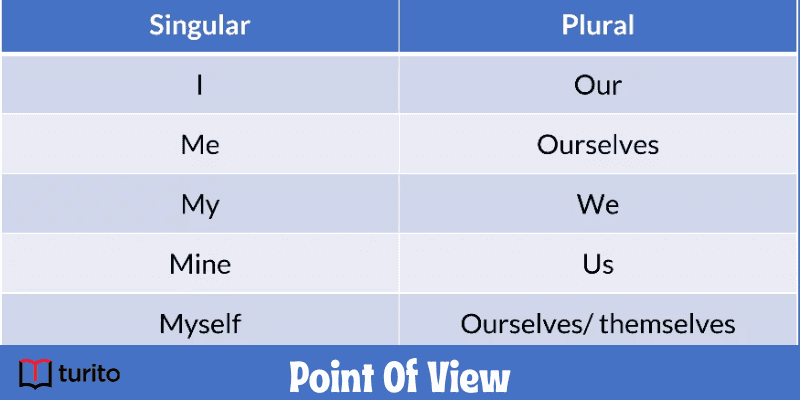
- First person can be singular or plural.
The first point of view is identified by the singular pronouns such as me, my , I mine, myself or plural first persons like we us our and ourselves.

Let us identify the first- person point of view from an example.
I saw the ‘closed’ sign dangling from the shop window, but I could hear someone moving inside. I stood on tiptoes to look through the glass and saw a pair of eyes staring back at me.
Here, the reader is being told about the narrator’s experience.
It’s like hearing a story from a friend… but the scene would be more immersive – would allow the reader to take up that primary position.
Read the following passages and identify the first- person point of view.
Passage 1
I always admired Tom, and fully expected him to accomplish great things. I look forward to sharing his accomplishments with you.
This is the first-person point of view as the narrator is explaining what is it about in the passage.
Passage 2
Jane was really looking forward to her upcoming vacation. Her boss knew she had earned the time off, but was concerned about some upcoming deadlines.
This is not considered as the first- person point of view as the passage is told by the other person other than the narrator.
Related topics

Informational Text – Features, Types with Examples
What is an Information Text? Any piece of writing falls under the category of fiction or non-fiction. Fiction is a work of imagination (made up story), whereas non-fiction is based on facts and actual events or real people. Informational texts are non-fiction works that inform the readers about a specific topic. They are found in […]

Figurative Language : Types and Examples
Figurative Language What is Figurative Language? A language that describes something by comparing it with something else, you are using figurative language. Types of Figurative Language: Imagery The Language that appeals to the senses. Descriptions of people or objects are stated in terms of our senses. Simile It includes a straight comparison between two unlike things, […]

Types and Uses of Punctuation Marks with Examples
Imagine reading a story with no full stops, no commas, and no question marks! You will not be able to understand what it meant. It would feel messy and hard to follow. That is where punctuation marks come in. They help organise our thoughts and make writing easier to read. They show pauses, expressions, and […]
Naming Words for Class 2: Simple English Guide
Naming words are names of people, animals, birds, places or things. E.g. Leo, Rat, Crow, London, Book Four types of naming words E.g. Leo, Andrea, Father, Mother E.g. School, London, Park, New york E.g. Tiger, Monkey, Cow, Parrots E.g. Box, Pen, Apples, Car Everything that we can touch, feel, see and talk about is represented by […]


Other topics



Comments: