



Learn Key Prepositions for Grade 9 with Simple Explanations

Prepositions are utilized to express the relationship of a noun or pronoun to the other part of the sentence. The noun or pronoun that is joined by the preposition is known as the object of the preposition.
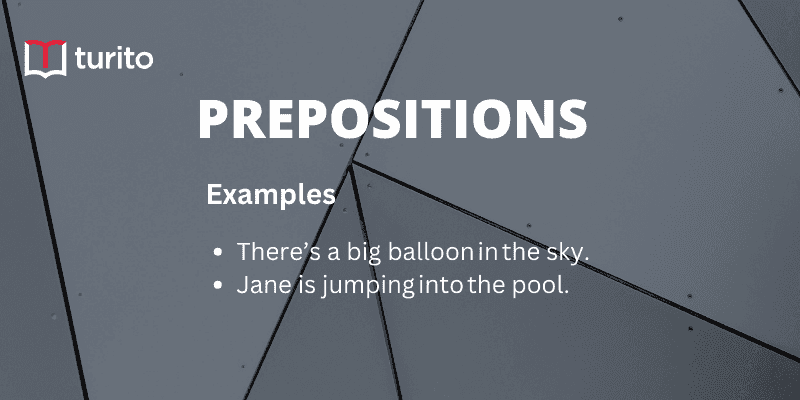
- There’s a big balloon in the sky.
- Jane is jumping into the pool.
A preposition is usually preceded a noun phrase.
Some prepositions can also come before an adverb.
Prepositions can also come before a gerund.
A preposition of place portrays where something is located in reference to something else, or where something occurred or will occur.

- All children fear the darkness below/under their beds.
- The design above/over the hallway reminded Natalie of a castle she’d visited.
A preposition of direction or movement portrays how, where, or in what way something moves.
- My sister went to Europe with her friends.
- The best friends rode their bicycles along the road.
A preposition of time portrays when or for how long something occurred or will occur.
- Let’s meet at noon.
- Chris arrived at one o’clock.
A preposition of agency portrays a person or a thing that has caused or is causing something to occur.
- The house was built by the three siblings.
A preposition of instrument or device is used when describing certain technologies, machines, or devices.
- Aunt Patricia returned home by ferry.
A preposition of reason or purpose describes why something has occurred or will occur.
- Everything I did was for you.
- Through her bravery, we were able to escape unharmed.
A preposition of connection describes possession, relationships, or accompaniment.
- The Statue of Liberty is located in New York Harbor.
- A well-written essay is impressive to teachers.
Prepositions and their objects together form prepositional phrases, which can function as either adjectives or (more commonly) adverbs.
- He arrived to school in a red car.
- We keep the lawnmower in the shed out back.
Certain prepositions can be utilized in conjunction with nouns to connect, emphasize, or provide clarification for ideas expressed in sentences.
Few verbs require prepositions to connect to their sentences’ objects. These combinations are also known as prepositional verbs.
When a prepositional phrase revises a verb, adjective, or adverb, it is considered to have the function of an adverb within the sentence. These phrases are known as adverbial prepositional phrases, or sometimes just adverb prepositional phrases, or adverb phrases.
Prepositional idioms combine prepositions with verbs, nouns, or phrases to create idiomatic expressions.
- I dialed the wrong number by mistake.
Related topics

Informational Text – Features, Types with Examples
What is an Information Text? Any piece of writing falls under the category of fiction or non-fiction. Fiction is a work of imagination (made up story), whereas non-fiction is based on facts and actual events or real people. Informational texts are non-fiction works that inform the readers about a specific topic. They are found in […]

Figurative Language : Types and Examples
Figurative Language What is Figurative Language? A language that describes something by comparing it with something else, you are using figurative language. Types of Figurative Language: Imagery The Language that appeals to the senses. Descriptions of people or objects are stated in terms of our senses. Simile It includes a straight comparison between two unlike things, […]

Types and Uses of Punctuation Marks with Examples
Imagine reading a story with no full stops, no commas, and no question marks! You will not be able to understand what it meant. It would feel messy and hard to follow. That is where punctuation marks come in. They help organise our thoughts and make writing easier to read. They show pauses, expressions, and […]
Naming Words for Class 2: Simple English Guide
Naming words are names of people, animals, birds, places or things. E.g. Leo, Rat, Crow, London, Book Four types of naming words E.g. Leo, Andrea, Father, Mother E.g. School, London, Park, New york E.g. Tiger, Monkey, Cow, Parrots E.g. Box, Pen, Apples, Car Everything that we can touch, feel, see and talk about is represented by […]


Other topics



Comments: