



Preposition : Meaning Examples

Preposition
It is set of words that is used before a noun, pronoun, or noun phrase to indicate direction, time, place, location, spatial relationships, and so on.
Prepositions are widely used to illustrate a spatial or temporal relationship, as well as a logical relationship between two or more people, places, or things.
What are a Prepositions?
A preposition is a set of words that comes before a noun, pronoun, or noun phrase to indicate direction, time, place, location, spatial relationships, or to introduce an object. Words like “in,” “at,” “on,” “of,” and “to” are examples of prepositions. In English, prepositions are quite idiomatic.
- Prepositions showcase how other words in a sentence are connected.
- Most prepositions show the location of something or the time it occurred.
- Because most prepositions have many definitions, their meaning varies greatly depending on the context.
- It is not a grammatical error to end a sentence with a preposition.
When it comes to prepositions, there is only one easy guideline to follow. And, unlike other regulations, there are no exceptions to this one.
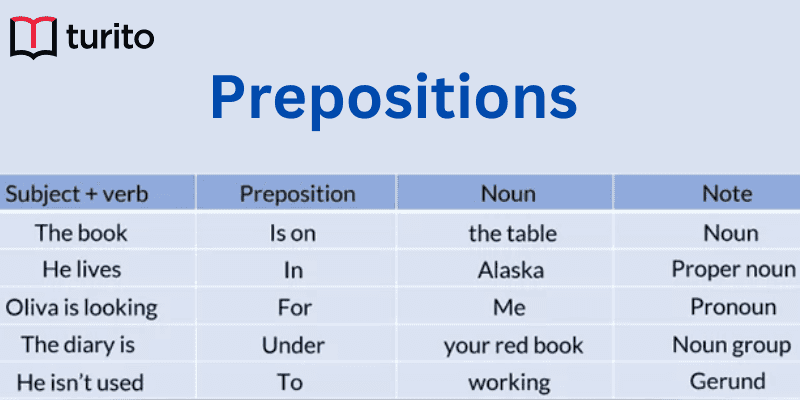
- A preposition is always followed by a “noun.” There is never a verb after it.
- A preposition cannot be preceded by a verb. If we wish to employ a verb to follow a preposition, we must use the “-ing” form, which is actually a gerund or verb in noun form.
Examples:


Let’s have a look at prepositions of Time, Place, Directions and Movement:
- Prepositions of Time:
These prepositions are used to describe time in a variety of ways.
For example: by, in, at, after, before, from, since, while, and so on
- He reached at 12 ‘o’ clock in the night. (Definite at midnight; point of time)
- Prepositions of Place:
Indicate where something happens
For example: on, in, by, from, to, towards, up, down, across, between, among, through, in front of, behind, above, over, under, below, etc.
He brought these shoes from the market. [ From is placed with the point of departure.]
- Prepositions of Directions:
The way a person or thing moves or is directed in respect to other people and things is described by prepositions of direction.
To describe the direction, prepositions such as to, towards, through, and into are employed.
For example: Up, down, across, between, among, through, in front of, behind, above, over, beneath, below, etc.
- The boy was sitting among his friends. [Among is used to describe the prepositions of direction
- Prepositions of Movement:
Movement prepositions depict movement from one location to another. We frequently use these prepositions with verbs of motion since they invariably depict movement. The preposition to, which describes movement in the direction of something, is the most prevalent preposition of movement.
For example: to, towards, through, into, over, across, etc.
- How do you get to work?
Related topics

Informational Text – Features, Types with Examples
What is an Information Text? Any piece of writing falls under the category of fiction or non-fiction. Fiction is a work of imagination (made up story), whereas non-fiction is based on facts and actual events or real people. Informational texts are non-fiction works that inform the readers about a specific topic. They are found in […]

Figurative Language : Types and Examples
Figurative Language What is Figurative Language? A language that describes something by comparing it with something else, you are using figurative language. Types of Figurative Language: Imagery The Language that appeals to the senses. Descriptions of people or objects are stated in terms of our senses. Simile It includes a straight comparison between two unlike things, […]

Types and Uses of Punctuation Marks with Examples
Imagine reading a story with no full stops, no commas, and no question marks! You will not be able to understand what it meant. It would feel messy and hard to follow. That is where punctuation marks come in. They help organise our thoughts and make writing easier to read. They show pauses, expressions, and […]
Naming Words for Class 2: Simple English Guide
Naming words are names of people, animals, birds, places or things. E.g. Leo, Rat, Crow, London, Book Four types of naming words E.g. Leo, Andrea, Father, Mother E.g. School, London, Park, New york E.g. Tiger, Monkey, Cow, Parrots E.g. Box, Pen, Apples, Car Everything that we can touch, feel, see and talk about is represented by […]


Other topics



Comments: