



Present Continuous Tense

Read the following sentences:
- Robert is swimming in the pool.
- Students are playing football during the sports hour.
- Mary is writing a letter.
The present progressive tense is used to indicate an action that is happening at the moment or a temporary change from the usual.
- It expresses the idea that something is happening now, at this very moment.
- It can also be used to show that something is not happening now.
Examples:
- I’m reading at the moment. [Unfinished action now]
- She’s staying with her cousin for a week. [Temporary situation]
- He’s eating a lot these days. [Temporary habit]
- I’m meeting my father tomorrow. [Definite future plan]
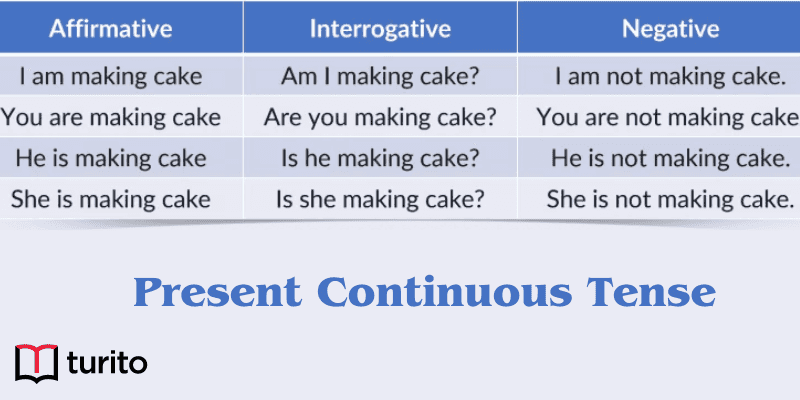
The structure of a sentence that is written in the Positive Present Continuous – (subject + auxiliary verb + ‘ing’ form of the main verb)
- Rita is coloring a flower.
- I am teaching.
Negative present continuous tense remains the same as the Positive sentences, with the only difference being the addition of ‘not’ between the auxiliary verb and the ‘ing’ form of the main verb. Structure- (Subject + Aux verb + not + ‘ing’ form of verb)
Examples:

- John is eating bread.
Negative: John is not eating bread.
- We are reading a book.
Negative: We are not reading a book.
Questions pattern in the Present Continuous is- Am/is/are + subject + verb +ing.
Examples:
- He is running on the jogging track.
Question: Is he running on the jogging track?
- She is watching a movie.
Question: Is she watching a movie?

Related topics

Informational Text – Features, Types with Examples
What is an Information Text? Any piece of writing falls under the category of fiction or non-fiction. Fiction is a work of imagination (made up story), whereas non-fiction is based on facts and actual events or real people. Informational texts are non-fiction works that inform the readers about a specific topic. They are found in […]

Figurative Language : Types and Examples
Figurative Language What is Figurative Language? A language that describes something by comparing it with something else, you are using figurative language. Types of Figurative Language: Imagery The Language that appeals to the senses. Descriptions of people or objects are stated in terms of our senses. Simile It includes a straight comparison between two unlike things, […]

Types and Uses of Punctuation Marks with Examples
Imagine reading a story with no full stops, no commas, and no question marks! You will not be able to understand what it meant. It would feel messy and hard to follow. That is where punctuation marks come in. They help organise our thoughts and make writing easier to read. They show pauses, expressions, and […]
Naming Words for Class 2: Simple English Guide
Naming words are names of people, animals, birds, places or things. E.g. Leo, Rat, Crow, London, Book Four types of naming words E.g. Leo, Andrea, Father, Mother E.g. School, London, Park, New york E.g. Tiger, Monkey, Cow, Parrots E.g. Box, Pen, Apples, Car Everything that we can touch, feel, see and talk about is represented by […]


Other topics



Comments: