



Pronoun Verb Contraction – Concept and Its Types

Contractions are short forms of two words which are combined together. When combined together, these words omit certain letters or sounds.
An apostrophe (‘) is placed where the letters are omitted.
For example: did not = didn’t, I am = I’m, Let us = let’s
Here, “o” is omitted and apostrophe is added in its place.
In “I am”, “a” is omitted and an apostrophe is added to form I’m.

Contractions combine a pronoun or noun and a verb, or, a verb and not. The most common contractions are formed by combining verbs, auxiliaries or modals with other words.
Contractions can also occur after nouns, names, here, there, now and question words.
Pronoun – verb contractions
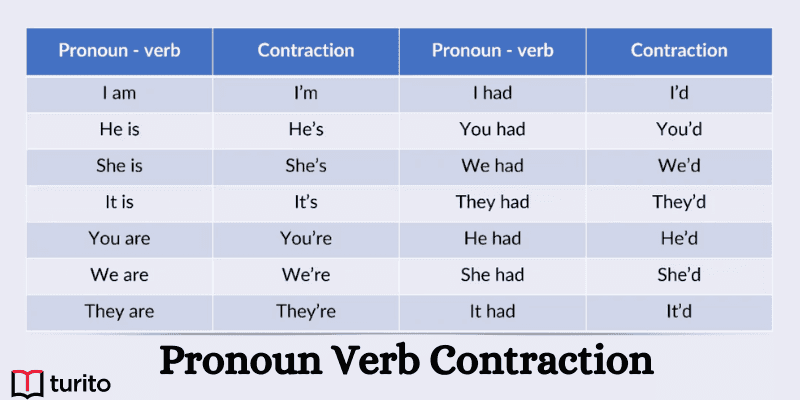
Pronoun verb contractions are formed by combining a pronoun and a verb together. Here, an apostrophe is used instead of the omitted letters. One or more letters are removed from the words when they are joined.
- Some contractions omit the first letter of the second word(verb).
For example:
I am = I’m (Here, “a” is replaced by an apostrophe.)
- Some contractions omit the first two letters of the second word(verb).
I will = I’ll


Contractions and possessive pronouns
Contractions can be confused with possessive pronouns as they are pronounced in a similar way. Contractions use apostrophe whereas possessive pronouns do not.
Your and you’re
Your is the possessive pronoun for you.
For example: Your bag is in the classroom.
You’re is the contraction of you are.
For example: You’re a smart boy.
Its and it’s
Its, is the possessive pronoun for it.
For example: John has a puppy. Its name is Xylo.
It’s, is the contraction of it is.
For example: It’s very cool here.
Their, there and they’re
Their is the possessive pronoun for they.
For example: Their teacher is on leave today.
They’re is the contraction of they are.
For example: There are going on a trip tomorrow.
There shows the location of something.
For example: The church is over there.
Related topics

Informational Text – Features, Types with Examples
What is an Information Text? Any piece of writing falls under the category of fiction or non-fiction. Fiction is a work of imagination (made up story), whereas non-fiction is based on facts and actual events or real people. Informational texts are non-fiction works that inform the readers about a specific topic. They are found in […]

Figurative Language : Types and Examples
Figurative Language What is Figurative Language? A language that describes something by comparing it with something else, you are using figurative language. Types of Figurative Language: Imagery The Language that appeals to the senses. Descriptions of people or objects are stated in terms of our senses. Simile It includes a straight comparison between two unlike things, […]

Types and Uses of Punctuation Marks with Examples
Imagine reading a story with no full stops, no commas, and no question marks! You will not be able to understand what it meant. It would feel messy and hard to follow. That is where punctuation marks come in. They help organise our thoughts and make writing easier to read. They show pauses, expressions, and […]
Naming Words for Class 2: Simple English Guide
Naming words are names of people, animals, birds, places or things. E.g. Leo, Rat, Crow, London, Book Four types of naming words E.g. Leo, Andrea, Father, Mother E.g. School, London, Park, New york E.g. Tiger, Monkey, Cow, Parrots E.g. Box, Pen, Apples, Car Everything that we can touch, feel, see and talk about is represented by […]


Other topics



Comments: