



Fun & Simple Pronouns Guide for Grade 3 Learners

Words that take the place of nouns are called as pronouns.
They are used instead of nouns.
For example:
- He
- She
- It
- They
- You
- We
Pronouns help us to shorten our sentences. They prevent nouns from repeating.
For example:

- Sandra was cleaning the room. She started cleaning early in the morning.
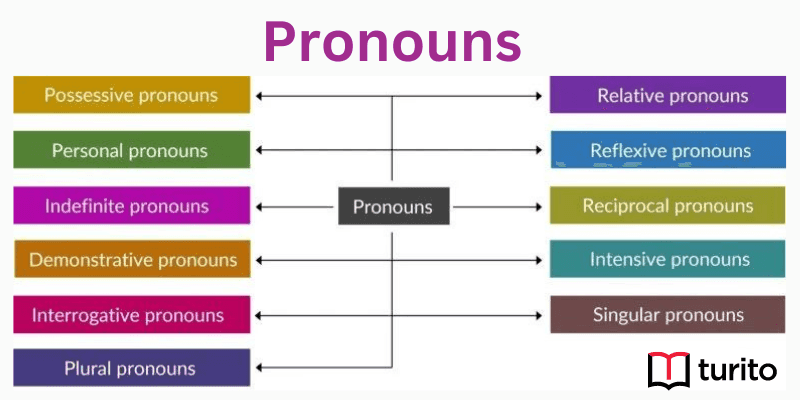
Types of Pronouns
The different types of pronouns are:

Personal pronouns
These are used to refer to people and sometimes animals.

For example:
- Are you coming for the trip?
Possessive pronouns
These pronouns are used to show ownership or possession.

For example:
- The book is mine.
Relative pronouns
These pronouns begin a relative clause.

For example: Who, whom, which
- Which is your bag?
Reciprocal pronouns
These pronouns are used to show mutual relationships or actions.
For example: Each other, one another
- Friends help each other.
Singular pronouns
These pronouns refer to a single person or thing. They use singular verbs.
For example: I, he, she, someone, something
- She gave me a pen.
Plural pronouns
These pronouns refer to more than one person or thing. They use plural verbs.
For example: We, they, them, ourselves, these
- We go to school by bus.
Related topics

Informational Text – Features, Types with Examples
What is an Information Text? Any piece of writing falls under the category of fiction or non-fiction. Fiction is a work of imagination (made up story), whereas non-fiction is based on facts and actual events or real people. Informational texts are non-fiction works that inform the readers about a specific topic. They are found in […]

Figurative Language : Types and Examples
Figurative Language What is Figurative Language? A language that describes something by comparing it with something else, you are using figurative language. Types of Figurative Language: Imagery The Language that appeals to the senses. Descriptions of people or objects are stated in terms of our senses. Simile It includes a straight comparison between two unlike things, […]

Types and Uses of Punctuation Marks with Examples
Imagine reading a story with no full stops, no commas, and no question marks! You will not be able to understand what it meant. It would feel messy and hard to follow. That is where punctuation marks come in. They help organise our thoughts and make writing easier to read. They show pauses, expressions, and […]
Naming Words for Class 2: Simple English Guide
Naming words are names of people, animals, birds, places or things. E.g. Leo, Rat, Crow, London, Book Four types of naming words E.g. Leo, Andrea, Father, Mother E.g. School, London, Park, New york E.g. Tiger, Monkey, Cow, Parrots E.g. Box, Pen, Apples, Car Everything that we can touch, feel, see and talk about is represented by […]


Other topics





Comments: