



Pronoun and its Types with Examples

Pronouns
A pronoun is a word that is used instead of a noun to avoid repetition of the noun to which it refers.
For example, take the sentence:
- My friend will be coming here tonight. My friend likes to party.
We can prevent the repetition of the noun my friend in the following way: - My friend will be coming here tonight. He likes to party.
Here, the underlined word he is the pronoun for the noun my friend.
Present below sentences and ask to identify the pronoun in them:
- Bianca acted in a movie. She was amazing in it.
- Joshua played yesterday. He scored a hat-trick.
- My son went to school. He will be back by evening.
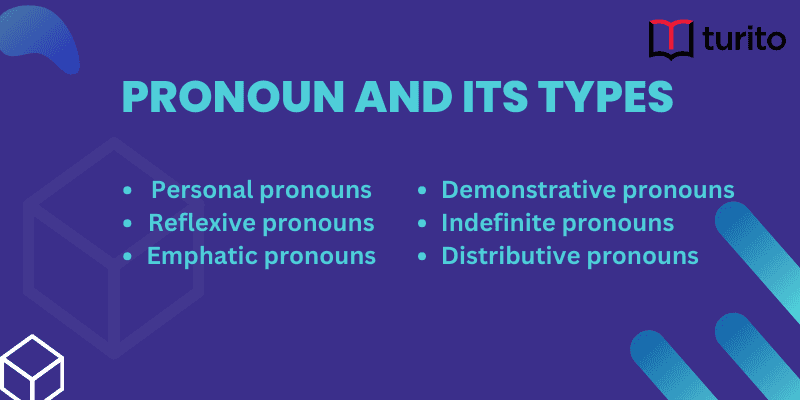
Types of pronouns:
- Personal pronouns
- Reflexive pronouns
- Emphatic pronouns
- Demonstrative pronouns
- Indefinite pronouns
- Distributive pronouns
1. Personal pronouns:
I, we, you, he, she, it, they are called the personal pronouns because they stand for the person speaking, the person spoken to, and the person spoken of.

The pronouns I and we are said to be first person pronouns because they denote the person/s speaking.
Example: I play football.
We went to the church in the morning.
The pronoun you is called the second person pronoun as it denotes the person/s spoken to.
Example: You should come with us.
The pronouns he, she, it, they are said to be third person pronouns as they denote the person/s spoken of.
Example: She is a good hockey player.
He is studying for the test.
It is her book.
2. Reflexive pronouns:
When we add –self to my, your, him, her, it and -selves to our, your, them, we get reflexive pronouns. They are called ‘reflexive’ because they turn the action done by the subject back to the subject itself.
Example:
- Don’t torture yourself.
- They did it themselves.
3. Emphatic pronouns:
When –self and –selves are used to show emphasis or to stress on something, they are called emphatic pronouns.
Examples:
- I will rebuild it by myself.
- We saw the President himself.
4. Demonstrative pronoun:
Pronouns like this, these, that, those are used to point out the objects they are referring to. They are called demonstrative pronouns.
Examples:
- This is a present from my aunt.
- Both the shoes are good, but this is better than that.
5. Indefinite pronouns:
Pronouns such as one, none, such, many, anybody, everybody, everyone, anyone, few are used to refer to people or things in general, but they cannot refer to a specific person or thing. They are known as indefinite pronouns.
Examples:
- Somebody is knocking at the door.
- Did you ask anybody to come?
- Some say that the show won’t begin on time.
- Many of them wore black suits.
6. Distributive pronouns:
Pronouns such as each, either, neither are called distributive pronouns. They are called so because they refer to persons or things at a time.
Example:
- The pens cost me half a dollar each.
- Either of you can stay.
Related topics

Informational Text – Features, Types with Examples
What is an Information Text? Any piece of writing falls under the category of fiction or non-fiction. Fiction is a work of imagination (made up story), whereas non-fiction is based on facts and actual events or real people. Informational texts are non-fiction works that inform the readers about a specific topic. They are found in […]

Figurative Language : Types and Examples
Figurative Language What is Figurative Language? A language that describes something by comparing it with something else, you are using figurative language. Types of Figurative Language: Imagery The Language that appeals to the senses. Descriptions of people or objects are stated in terms of our senses. Simile It includes a straight comparison between two unlike things, […]

Types and Uses of Punctuation Marks with Examples
Imagine reading a story with no full stops, no commas, and no question marks! You will not be able to understand what it meant. It would feel messy and hard to follow. That is where punctuation marks come in. They help organise our thoughts and make writing easier to read. They show pauses, expressions, and […]
Naming Words for Class 2: Simple English Guide
Naming words are names of people, animals, birds, places or things. E.g. Leo, Rat, Crow, London, Book Four types of naming words E.g. Leo, Andrea, Father, Mother E.g. School, London, Park, New york E.g. Tiger, Monkey, Cow, Parrots E.g. Box, Pen, Apples, Car Everything that we can touch, feel, see and talk about is represented by […]


Other topics



Comments: