



Power of a Lens – Definition and Formula

Power of a Lens

 Introduction
All the lenses do not converge or diverge the light rays falling on them by the same amount. Lenses of different kinds and different focal lengths act on a light ray falling on them differently. In this section we will look at the term which measures this mathematically.
 Explanation
Power of a lens:
The converging ability of the lens varies inversely as the focal length of a convex lens and the diverging ability of the lens varies inversely as the focal length of a concave lens.
The degree of convergence or divergence of light rays achieved by a lens is expressed in terms of its power.
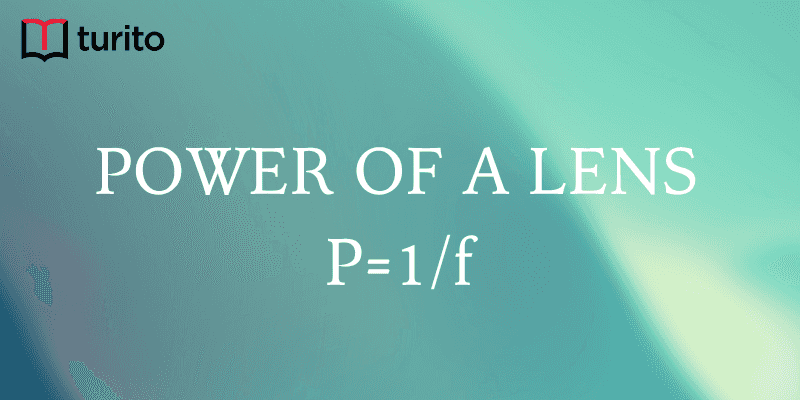
The power of a lens is equal to the reciprocal of the focal length of the lens.

Where P is the power of a lens and f is its focal length.

This means that, a convex lens of short focal length bends the light rays through large angles by focusing them closer to the optical center.
And a concave lens of very short focal length causes a higher divergence than the one with a longer focal length.
The SI unit of the power of a lens is dioptre (D).
If the focal length of the lens ‘f’ is expressed in meters, then the power is expressed in dioptres.
Therefore, 1 D is the power of a lens with focal length 1 m.
The focal length of a convex lens is positive whereas, the focal length of a concave lens is negative.
Therefore, the power of a convex lens is positive and that of a concave lens is negative.
Questions and Solutions:
- What is the power of the lens used in your spectacles? Calculate its focal length and identify the kind of lens used in it.
Solution:
Suppose the power of the lens in the spectacles is – 2.25 D.
P = 1/f
f = 1/P
f = 1/–2.25
f = – 100/225
f = – 4/9
f = – 0.44 m
f = – 44 cm
As the focal length turned out to be negative the lens used is a concave lens.
- What is the power of the lens whose focal length is 80 cm? Identify the kind of lens used in it.
Solution:
The focal length is given to be 80 cm = 0.8 m
P = 1/f
P = 1/0.8
P = 10/8
P = 1.25 D
As the focal length and the power, both are positive the lens used is a convex lens.
Summary
- The degree of convergence or divergence of light rays achieved by a lens is expressed in
terms of its power. - The power of a lens is equal to the reciprocal of the focal length of the lens.
P= 1 / f , where P is the power of a lens and f is its focal length. - The power of a lens varies inversely as the focal length of the lens.
- The SI unit of the power of a lens is “dioptre” (D). If the focal length of the lens ‘f is
Related topics
Velocity Time Graphs – Definition, Examples
Key Concepts 1. Velocity-time graph 2. Slope of v-t graph = acceleration 3. Types of velocity-time graphs 4. Displacement from v-t graphs What is Velocity Time Graph A velocity time graph is a simple graph that shows you how the velocity of an object changes with time. In this graph: It tells us: You can […]

5 Types Of Mechanical Layers Of The Earth
Composition Layer of the Earth When we are studying the layers of the Earth, it can be divided into two ways. One is by how they move, which is the mechanical layers. The other is by what they are made of. This second way involves the composition of layers of the Earth. Based on the […]
Effects of Force: Types, Examples, and Applications
Effects of Force Key Concepts What Is Force? A force comes into play when two or more objects interact with each other. This force when applied to an object by another, gives rise to some kind of change in the state of motion of an object. In this section we will be looking at these […]

Electrical Components and Symbols Explained with Diagrams
What Are Electrical Components? Consider the electrical components as the building blocks of any circuit. These are the actual components that cause electricity to do what you want it to do. Every switch you flip, every fan that spins, every charger that doesn’t overheat relies on these small parts doing their job quietly. You rarely […]


Other topics





Comments: