



2 Dimensional Shapes

Key Concepts
- Different shapes.
- Shapes into categories based on their attributes.
Shapes
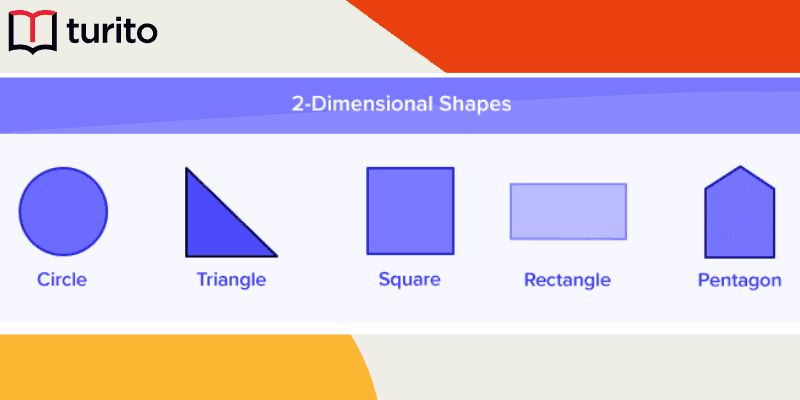
We come across different shapes around us in day-to-day life. So, let us observe the below figure and recall the shapes:
Name the different shapes in the picture given below.

Answer:
- Circle
- Square
- Rectangle
- Triangle
Identify the different shapes and count them.

Answer:

- Number of circles: 4
- Number of triangles: 5
- Number of squares: 3
- Total number of shapes: 12
2-Dimensional Shapes
- Triangle
- Quadrilateral
- Pentagon
- Hexagon
Triangle & Its Attributes
A triangle has 3 sides and 3 vertices.

Some more different types of triangles are given below:

Not triangles
These are the shapes which are not triangles.

Quadrilateral & Its Attributes
A quadrilateral has 4 sides and 4 vertices.

Some more different types of quadrilaterals are given below:

Not quadrilaterals
These are the shapes which are not quadrilaterals.

Pentagon, Hexagon & Their Attributes
Pentagon & its Attributes
- It has 5 sides.
- It has 5 vertices.

Hexagon & Its Attributes
- It has 6 sides.
- It has 6 vertices.

Not pentagons and not hexagons:
Below are the shapes which are not pentagons and hexagons.

Exercise
- Name all the shapes used in the picture.

- Observe the picture and find the number of circles, triangles, quadrilaterals, and pentagons.

- Find the total number of triangles in the picture.

- Name each shape. Find the number of sides and vertices.

- Identify the shape which is not a hexagon

- Connect all the dots to make shapes that have vertices. Name the shapes that you make.

Concept Map

What we have learned
- Recognizing different shapes.
- Sorting shapes into categories of triangle, quadrilateral, pentagon, and hexagon based on their attributes
Related topics

Square 1 to 20 : Chart, Table, Perfect Squares and Examples
Square 1 to 20 When you multiply a number by itself, the result is called a square. And when you’re preparing for exams, you need to have a foundation for algebra and quick mental math because you get a really short time to do your exam. Therefore, learning the squares from one to twenty is […]

Square 1 to 40 : Table, Perfect Squares, Chart and Examples
Square 1 to 40 When you multiply a number by itself, the resulting number is a square, and if you are someone who is either appearing in a competitive exam or just wants to do well in math in school, knowing square 1 to 40 is a really important skill. But manually multiplying every time, […]

Square Root : Definition, Formula, Methods and Types Explained
Square Root Square roots are one of those seemingly daunting maths topics that appear in many different situations, from algebra to geometry. Yet the concepts behind them aren’t as hard to grasp. It makes handling numbers far easier if you know the concept well. Let us understand how to find the square roots of a number […]

Cubes 1 to 20 : Chart, Table, Memory Tricks and Examples
Most students don’t struggle much with smaller cubes like 2³ or 3³. Those usually come quickly. The hesitation starts with numbers like 11³ or 17³. Or when someone suddenly asks, what is 20 cubed? That pause is not a memory problem. It’s about the lack of proper understanding and hence confidence. Naturally, learning cubes 1 […]


Other topics



Comments: