



Angles – Definition, Properties, Example,& Figures

Key Concepts
- To understand angles and unit angles
- To measure with unit angles
- To measure and draw angles
- To add and subtract angle measures
Understand Angles and Unit Angles
Angle:

An angle is the rotation of a ray from an initial point to a terminal point.
Types of Angles:
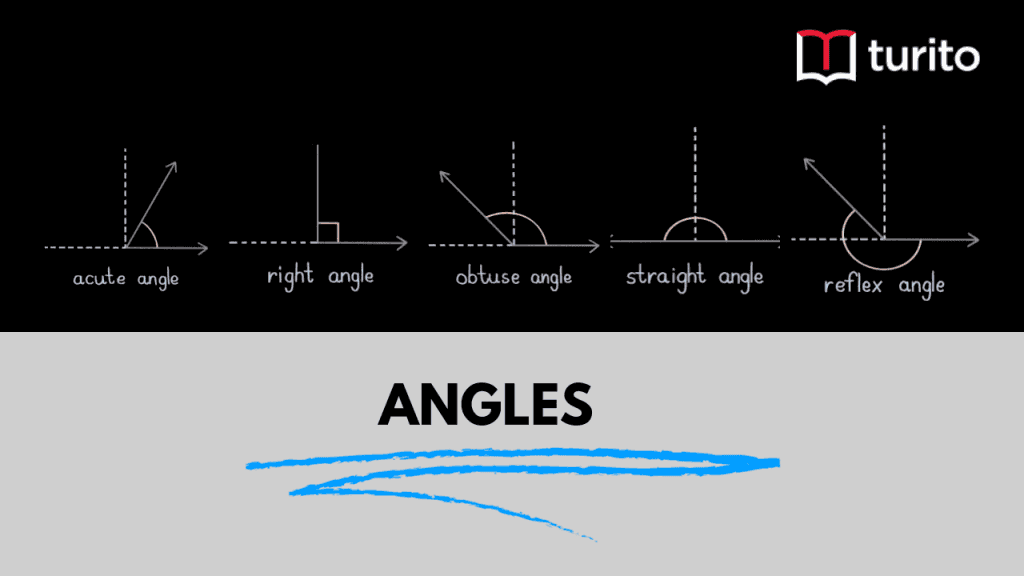
There are majorly six types of angles in geometry:
- Acute angle: It lies between 0° to 90°.
- Obtuse angle: It lies between 90° to 180°.
- Right angle: The angle which is exactly equal to 90°.
- Straight angle: The angle which is exactly equal to 180°.
- Reflex angle: The angle which is greater than 180° and less than 360°.
- Full rotation: The complete rotation of an angle equal to 360°.

Unit Angle:
- An angle is measured with units called degrees (ᵒ).
- An angle that turns through 1 / 360 of a circle is called a unit angle.

Examples of angles with their measurements:

Measure with Unit Angles
Unit angles are measured using a smaller angle to measure a larger angle by repeating the unit.


Unit angle
Example:
What is the measurement of the smaller angle formed by the clock hands when it is 5 o’clock?

Measure and Draw Angles
Measuring angles with a protractor
Angles are measured in degrees. The symbol for degrees is a small circle °.

Protractor
- The full circle is 360° (360 degrees).
- A half-circle or a straight angle is 180°.
- A quarter-circle or a right angle is 90°.
How to measure an angle with a protractor?
A protractor is a tool that is used to measure and draw angles.

Protractor
- Place the midpoint of the protractor on the vertex of the angle.
- Line up one side of the angle with the line zero of the protractor
(Where you see the number 0). - Read the degrees where the other side crosses the number scale.

Example:
Draw ∠ABC=60° with a ruler and a protractor.
- Draw a straight-line AB.
- Place a dot at B. This dot represents the vertex of the angle.
- Place the center of the protractor at B and the baseline of the protractor along with the arm BA.
- Find 60° on the scale and mark a small dot at the edge of the protractor.
- Join the vertex B to the small dot with a ruler to form the second arm, BC, of the angle.
- Mark the angle with a small arc as shown.

Add and Subtract Angle Measures
Finding the measure of an unknown angle by using the known measures.
If ∠ABD = 107°, what is the measure of ∠ABC?

We know that:
∠ABC + ∠CBD = ∠ABD
Plug in the known: n + 37° = 107°
Use the inverse operation to isolate the variable n = 107° – 37° = 70°
So, ∠ABC = 70°.
Exercise:
- Use a protractor to draw an angle measure for 650.
- How many 600 angles does it take to make a full turn?
- How many degrees are in a twelfth of a full turn?
- What fraction of the circle does a 1200 angle turn through?
- What are the measures of an angle?
- What are the 5 types of angles?
- What is a zero angle?
- Find the following missing angles.

- Find the unknown angles from the figure below.

- What is the value of x?

What have we learnt:
- To use and apply vocabulary associated with angles.
- To identify examples of different types of angles.
- To measure and draw angles with a protractor.
- To understand angles and unit angles.
- To add and subtract angle measures.
Concept Map:

Related topics

Square 1 to 20 : Chart, Table, Perfect Squares and Examples
Square 1 to 20 When you multiply a number by itself, the result is called a square. And when you’re preparing for exams, you need to have a foundation for algebra and quick mental math because you get a really short time to do your exam. Therefore, learning the squares from one to twenty is […]

Square 1 to 40 : Table, Perfect Squares, Chart and Examples
Square 1 to 40 When you multiply a number by itself, the resulting number is a square, and if you are someone who is either appearing in a competitive exam or just wants to do well in math in school, knowing square 1 to 40 is a really important skill. But manually multiplying every time, […]

Square Root : Definition, Formula, Methods and Types Explained
Square Root Square roots are one of those seemingly daunting maths topics that appear in many different situations, from algebra to geometry. Yet the concepts behind them aren’t as hard to grasp. It makes handling numbers far easier if you know the concept well. Let us understand how to find the square roots of a number […]

Cubes 1 to 20 : Chart, Table, Memory Tricks and Examples
Most students don’t struggle much with smaller cubes like 2³ or 3³. Those usually come quickly. The hesitation starts with numbers like 11³ or 17³. Or when someone suddenly asks, what is 20 cubed? That pause is not a memory problem. It’s about the lack of proper understanding and hence confidence. Naturally, learning cubes 1 […]


Other topics



Comments: