



Area of a Rectangle – Formula, Examples & Practice

Key Concepts
- Properties of a square
- Properties of a rectangle
- Area of a square
- Area of a Rectangle
7.1 Properties of Square:
- What is a Square?

A SQUARE has
- Four sides.
- Four corners.
Note: All sides are of equal length in a square.
Example of Square:

7.2 Properties of Rectangle:
- What is a Rectangle?

A RECTANGLE has
- Four sides.
- Four corners.
Note: The opposite sides are of equal length in a rectangle.

Example of Rectangle

How to Measure Area of a Square
The Area of a Square by multiplying the length of the two sides. Since the length of the sides are the same in a Square as given in below picture.

If Side = “S”

THE AREA OF A SQUARE = S x S
Area is measured in “square” units
Note: S x S is not equal to 2 x S.
Number of Squares = 16
Area of a Square = 16 square units
Area of a Square = Side x Side
= 4 x 4
= 16 Square units
Assessment: Try this
- Calculate the area of the square floor area whose length of each side is 10 Mts?
Note:
- All the sides in a square have the same length.
- All the lengths are measured in units.
- Total area should me represented in square units only.
Solution:
Length of a each side = 10 Mts

Side = 10 Mts
Area of a Square = Side x Side
= 10 Mts x 10 Mts
Total floor area = 100 Sq.Mts
Note: Sq.Mts represents Square Meters
How to Measure Area of a Rectangle:
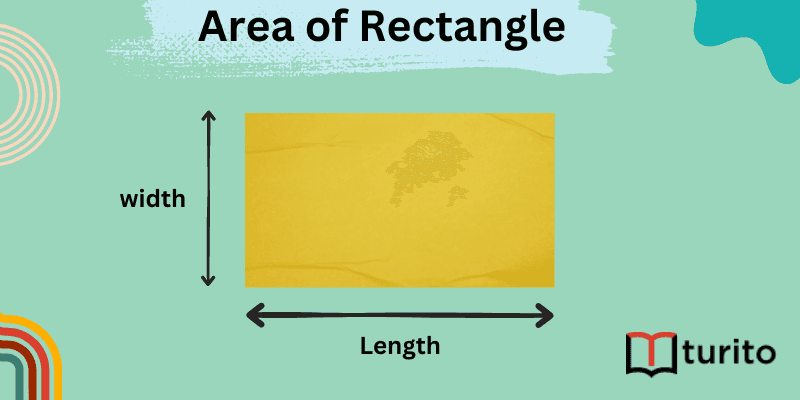
The Area of a Rectangle is found by multiplying the length and the width of a rectangle.
As the opposite sides are the same in a rectangle Area is calculated as
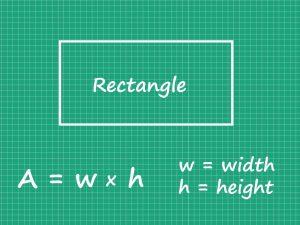
Area of the Rectangle = Length * Width
Note: Both length and width of opposite side are equal.

Number of Squares = 12
Area of rectangle = 12 square units

Finding Area using Array Method
Total number of Squares = Rows x columns
= 3 x 4
= 12
Total Area of a Rectangle = Total number of squares = 12 square units
Number of Squares = 15
Area of rectangle = 15 square units

Finding area using Array Method
Total number of Squares = Rows x columns
= 4 x 6
Area of a Rectangle = Total number of squares = 24 Square units

Example: Lets apply
- Calculate the area of the road whose length is 10 mts and width is 8 Mts?
Note:
- Opposite sides of a rectangle are equal.
- All the lengths and width of a area should be calculated on same units.
- Total area should me represented in square units only.
Solution:
Length of a each side = 10 Mts
Width of a each side = 8 Mts

Length = 10 Mts
Width = 8 Mts
Area of a Rectangle = Length x Width
= 10 Mts x 8 Mts
Total Road area = 80 Sq.Mts
Note: Sq. Mts represents Square Meters
Every square is a rectangle
For Example side of a square = 6 feet
Area of the square = Side x side = 6 x 6 = 36 square feet
Foe a square length = width = side
Area = length x width = 6 x 6 = 36 square feet

Every Rectangle is not a Square
For Example if Length = 6 feet width = 4feet
Area = length x width= 6 x 4 = 24 square feet
For a rectangle length ≠ width
Both sides of the rectangle are not equal so Rectangle cannot be a square

Assessment
Jack is painting a wall in the school. The length of the wall is 6 feet and the width of the wall is 8 feet. The paint can Jack brought covers 40 square feet. Does Jack need more paint to paint the wall completely ? Discuss

Area of the wall in Mike’s room is 63 Sq feet. The length of the wall is 7 feet high. How much is the width of the wall?

Exercise:
- Jack is painting a wall in the school. The length of the wall is 6 feet and the width of the wall is 8 feet. The paint can Jack brought covers 40 square feet. Does Jack need more paint to paint the wall completely ? Discuss

2. Area of the wall in Mike’s room is 63 Sq feet. The length of the wall is 7 feet high. How much is the width of the wall?

What we have learnt:
- In a Square all sides are of equal length
- In a Rectangle opposite sides are of equal length
- Area is measured in “square” units
- Area of the Square = S x S
- Area of the Rectangle = Length * Width
- Area is measured using Standard units
- Every Square is a Rectangle
- Every Rectangle is not a Square
Related topics

Square 1 to 20 : Chart, Table, Perfect Squares and Examples
Square 1 to 20 When you multiply a number by itself, the result is called a square. And when you’re preparing for exams, you need to have a foundation for algebra and quick mental math because you get a really short time to do your exam. Therefore, learning the squares from one to twenty is […]

Square 1 to 40 : Table, Perfect Squares, Chart and Examples
Square 1 to 40 When you multiply a number by itself, the resulting number is a square, and if you are someone who is either appearing in a competitive exam or just wants to do well in math in school, knowing square 1 to 40 is a really important skill. But manually multiplying every time, […]

Square Root : Definition, Formula, Methods and Types Explained
Square Root Square roots are one of those seemingly daunting maths topics that appear in many different situations, from algebra to geometry. Yet the concepts behind them aren’t as hard to grasp. It makes handling numbers far easier if you know the concept well. Let us understand how to find the square roots of a number […]

Cubes 1 to 20 : Chart, Table, Memory Tricks and Examples
Most students don’t struggle much with smaller cubes like 2³ or 3³. Those usually come quickly. The hesitation starts with numbers like 11³ or 17³. Or when someone suddenly asks, what is 20 cubed? That pause is not a memory problem. It’s about the lack of proper understanding and hence confidence. Naturally, learning cubes 1 […]


Other topics



Comments: