



Converse Of Pythagoras Theorem

Key Concepts
• Pythagorean triples
• Application of converse of the Pythagorean theorem
• Identifying right angle triangle
• Acute triangle
• Obtuse triangle

Introduction:
The side opposite to the right angle of the right triangle is called the hypotenuse.
The other two sides are called the legs of the triangle. Of the two legs, one is called the base and the other height.
Since the sum of the angles in a triangle is 180
and in a right-angled triangle the one angle is 90o, then the sum of the other two angles will always be 90
7.1 Pythagorean Triples:
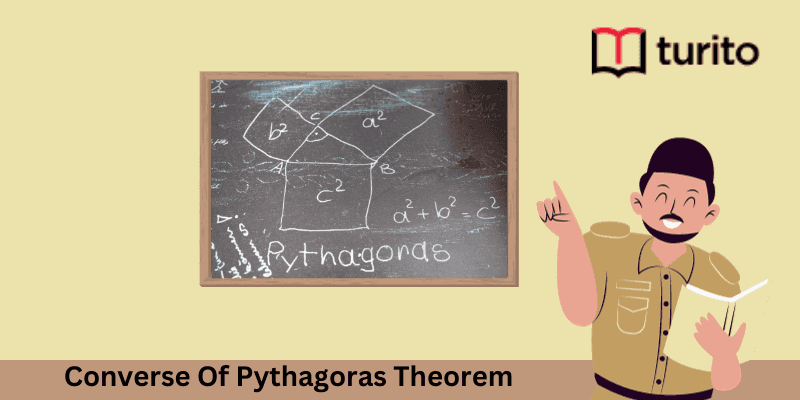
According to the Pythagoras theorem, the square of the length of the hypotenuse of a right triangle is equal to the sum of the squares of the lengths of the other two sides.
The integers that represent the values of a, b, c are called Pythagorean triples.
List of Pythagorean Triples
| Prime leg | Even leg | Hypotenuse |
| 3 | 4 | 5 |
| 5 | 12 | 13 |
| 7 | 24 | 25 |
| 9 | 40 | 41 |
| 11 | 60 | 61 |
| 19 | 180 | 181 |
7.2 Converse of Pythagoras Theorem:
The converse of the Pythagorean theorem helps determine whether the triangle is acute, right, or obtuse. It can be done by comparing the sum of the squares of two sides of a triangle to the square of its third side. The converse of the Pythagorean theorem states that if the square of the third side of a triangle is equivalent to the sum of its two shorter sides, then it must be a right triangle.
Converse of the Pythagorean Theorem

Then triangle ABC is a right triangle

If 52=42+32
Then triangle ABC is a right triangle
a2 + b2= c2, where c is the hypotenuse, i.e., the length of the longest side of a right-angle triangle.
Converse of Pythagoras Theorem Proof:
Statement: The converse of the Pythagorean theorem states that if the square of the third side of a triangle is equivalent to the sum of its two shorter sides, then it must be a right triangle.

Proof: Construct another triangle, △PQR, such as AC = PR = b and BC = QR = a.

In △PQR, by Pythagoras Theorem:
PQ2 = PR2 + QR2 = b2 + a2 ………. (1)
In △ABC, by Pythagoras Theorem:
AB2 = AC2 + BC2 = b2 + a2 ………. (2)
From equation (1) and (2), we have:
PQ2 = AB2
PQ = AB
=> △ACB≅△PRQ (By SSS postulate)
=>R is right angle
Thus, △PQR is a right triangle.
Hence, the converse of Pythagorean theorem is proved.
To identify the type of triangle, we can use the following formulas:
7.3 Determining Right Triangle:
If the sum of the squares of the shorter sides is equal to the square of the longest side, then the triangle is a right triangle. In other words, if a2 + b2 = c2 then, it is a right-angle triangle.

Let us apply the formula a2 + b2 = c2,
42 + 32 = 52
16 + 9 = 25
25=25
Since both the values are equal, it is a right-angle triangle.
7.4 Determining Acute Triangle:
If the sum of the squares of the shorter sides is larger than the square of the longest side, then the triangle is acute. In other words, if a2 + b2 > c2 then, it is an acute triangle.

a2 + b2 > c2
32 + 4.52 > 52
9 + 20.25 > 25
29.25 > 25
7.5 Determining Obtuse Triangle:
If the sum of the squares of the shorter sides is smaller than the square of the longest side, then the triangle is obtuse. In other words, if a2 + b2 < c2 then, it is an obtuse triangle.

a2 + b2 < c2
42 + 42 < 72
16 + 16 < 49
32 < 49
Exercise:
- Check whether a triangle with side lengths 6 cm, 10 cm, and 8 cm is a right triangle by applying the converse of the Pythagorean theorem. Check whether the square of the length of the longest side is the sum of the squares of the other two sides.
- Check whether the triangle with the side lengths 5, 7, and 9 units is an acute, right, or obtuse triangle by applying the converse of the Pythagorean theorem. The longest side of the triangle has a length of 9 units. Compare the square of the length of the longest side and the sum of squares of the other two sides.
- The height and base of a right-angled triangle are 24 cm and 18 cm. Find the length of its hypotenuse.
- From the given figure, in ∆ABC, if AD ⊥ BC, ∠C = 45°, AC = 82 , BD = 5, then find the value of AD and BC

- Complete the following activity to find the length of the hypotenuse of the right-angled triangle if the sides of the right angle are 9 cm and 12 cm.

- The sides of a triangle are of length 9 cm, 11 cm, and 6 cm. Is this triangle a right triangle? If so, which side is the hypotenuse?
- In △PQR, PQ = √8, QR = √5, and PR = √3. Is △PQR a right-angled triangle? If yes, which angle is 900?
- The diagram below shows the position of the three towns.
Lowtown is due west of Midtown.
The distance from- Lowtown to Midtown is 75 kilometers.
- Midtown to Hightown is 110 kilometers.
- Hightown to Lowtown is 85 kilometers.

Is Hightown directly north of Lowtown?
Justify your answer
- Calculate the length of the side marked AB. Give your answer to 2 decimal places.

- Calculate the length of x. Give your answer to 2 decimal places.

What we have learnt:
■ The set of Pythagorean triples
■ The converse of the Pythagoras theorem
■ How to identify the right angle if side lengths are known.
■ How to identify the acute angle if side lengths are known.
■ How to identify the obtuse angle if side lengths are known.
Related topics

Square 1 to 20 : Chart, Table, Perfect Squares and Examples
Square 1 to 20 When you multiply a number by itself, the result is called a square. And when you’re preparing for exams, you need to have a foundation for algebra and quick mental math because you get a really short time to do your exam. Therefore, learning the squares from one to twenty is […]

Square 1 to 40 : Table, Perfect Squares, Chart and Examples
Square 1 to 40 When you multiply a number by itself, the resulting number is a square, and if you are someone who is either appearing in a competitive exam or just wants to do well in math in school, knowing square 1 to 40 is a really important skill. But manually multiplying every time, […]

Square Root : Definition, Formula, Methods and Types Explained
Square Root Square roots are one of those seemingly daunting maths topics that appear in many different situations, from algebra to geometry. Yet the concepts behind them aren’t as hard to grasp. It makes handling numbers far easier if you know the concept well. Let us understand how to find the square roots of a number […]

Cubes 1 to 20 : Chart, Table, Memory Tricks and Examples
Most students don’t struggle much with smaller cubes like 2³ or 3³. Those usually come quickly. The hesitation starts with numbers like 11³ or 17³. Or when someone suddenly asks, what is 20 cubed? That pause is not a memory problem. It’s about the lack of proper understanding and hence confidence. Naturally, learning cubes 1 […]


Other topics





Comments: