



Equivalent Fraction : Concept with Examples

Key Concepts
- Equivalent fractions: Use models
- Equivalent fractions: Use the number line
Introduction:
Equivalent Fraction
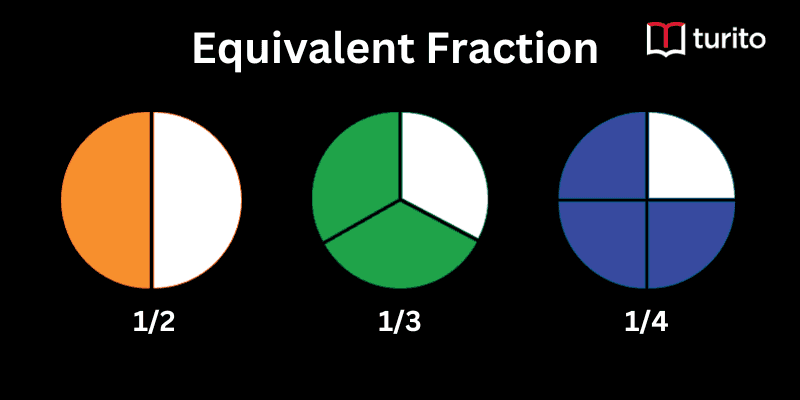
Equivalent fractions are fractions that have the same value, even though they may look different

The fractions 1/2, 2/4, 4/8 are equivalent since each represents the same number
Example
Use the below fraction strips to show that the fractions 1/2, 2/4, and 4/8 are equivalent

Step 1
Given fraction strips represent the parts of a whole

Consider the fractions 1/2 , 2/4

Now we have to show 1/2 and 2/4 are equivalent
Step 2

From the whole, divide the fraction and represent on the same number line, i.e., when we compare 1/2 and 1/4 as shown in the above figure, both the fractions represent the same number on the number line with equal fractions
Then we have = 1/2 = 2/4
Step 3
Similarly, the other fractions also represent the same part of the whole

Then we have = 1/2 = 2/4 = 4/8
Thus, the fractions ,1/2, 2/4 and 4/8 are equivalent since each represent the same number.
Example 2
Find a fraction that is equivalent to 2/3
Step 1
Let us draw an area model for 2/3

Step 2
Draw an identical model

The other model also shows the fraction 2/3
Step 3
To make an equivalent fraction, divide each part into equal parts.
Let us divide each part of the identical model into 2 equal parts.

Step 4
What fraction does the identical model show now?
The identical model is divided into 6 equal parts, and 4 parts are colored
So the identical model shows the fraction 4/6

Here we can see that 2/3 = 4/6 because the two fractions show the same part of a whole
13.2 Equivalent Fractions: Use the number line
Fractions on a number line:
How to recognize equivalent fractions using number lines?
- Draw a number line that goes from 0 to 1 since fractions are values that are less than 1.
- To show a fraction, first, divide the line into equal parts.
- The denominator of a fraction tells about the number of equal parts into which a number line should be divided.
- The numerator tells about the parts.
Here are some of the fractions marked on a number line


Example
Use the number line to represent a fraction equivalent to 2/3
Step 1
Draw a number line model for 2/3

Step 2
Draw an identical number line below it, with the same number of equal parts

Now, divide each part into smaller parts

What fraction of the number line is colored?
4 out of 6 parts are colored
Comparing the length of the two fractions
Therefore, the length of 2/3 is equal to the length of 4/6
This means that 2/3 is equivalent to 4/6
Exercise:
- Find the equivalent fraction in each case. Show on the fraction strip why your answer makes sense.

2. Find the following equivalent fractions:

3. Jane got 10 out of 15 for her test, and Mark got 15 out of 20 on his test. Rita said that they both did equally well because they both got 5 wrong. Is Rita correct? Explain your answer.
4. Are there fractions between 1/7 and 1/8? If so, name a fraction between 1/7 and 1/8.
5. A mural is divided into 3 equal parts. What fraction represents the entire mural?
6. Does ¼ name the unshaded part of the model? Explain.
7. Which is greater, 3/6 or 4/6? Use a number line to compare the fractions.
8. How can number lines show that two fractions are equivalent? Explain.
9. Rita says the fraction strips show fractions that are equivalent to ½. Explain what you could do to the diagram to see if she is correct.
10. Complete the number line to show that 2/6 and 1/3 are equivalent fractions.
What we have learned:
- How to develop an understanding of equivalent fractions using fraction strips
- How to identify and recognize equivalent fractions as part of a whole fraction
- How to write equivalent fractions on a number line
- Learned how to use number lines to represent equivalent fractions
- How to find equivalent fractions
Concept Map:


Fraction Strips Chart

Related topics

Square 1 to 20 : Chart, Table, Perfect Squares and Examples
Square 1 to 20 When you multiply a number by itself, the result is called a square. And when you’re preparing for exams, you need to have a foundation for algebra and quick mental math because you get a really short time to do your exam. Therefore, learning the squares from one to twenty is […]

Square 1 to 40 : Table, Perfect Squares, Chart and Examples
Square 1 to 40 When you multiply a number by itself, the resulting number is a square, and if you are someone who is either appearing in a competitive exam or just wants to do well in math in school, knowing square 1 to 40 is a really important skill. But manually multiplying every time, […]

Square Root : Definition, Formula, Methods and Types Explained
Square Root Square roots are one of those seemingly daunting maths topics that appear in many different situations, from algebra to geometry. Yet the concepts behind them aren’t as hard to grasp. It makes handling numbers far easier if you know the concept well. Let us understand how to find the square roots of a number […]

Cubes 1 to 20 : Chart, Table, Memory Tricks and Examples
Most students don’t struggle much with smaller cubes like 2³ or 3³. Those usually come quickly. The hesitation starts with numbers like 11³ or 17³. Or when someone suddenly asks, what is 20 cubed? That pause is not a memory problem. It’s about the lack of proper understanding and hence confidence. Naturally, learning cubes 1 […]


Other topics



Comments: