



Fractions – Definition, Parts, & Examples

Key Concepts
- Expressing fractions in tenths as decimals.
- Expressing fractions in hundredths as decimals.
- Comparing and ordering decimals.
- Number patterns.
Introduction:
- In this chapter, we will learn to express fractions as equivalent fractions with a denominator 10.
- Simplifying fractions with a denominator of 10.
- Rounding numbers to the nearest ten.
- Knowing fractions and mixed numbers.
Fractions:
Fractions are represented as numerical values and can be defined as the parts of a whole.
Parts of Fraction:
All fractions consist of a numerator and a denominator.
- The denominator indicates how many parts the whole has been divided into. It is placed in the lower part of the fraction.
- The numerator indicates how many sections of the fraction are represented. It is placed in the upper part of the whole.
Example:

Example:


Understanding Tenths:
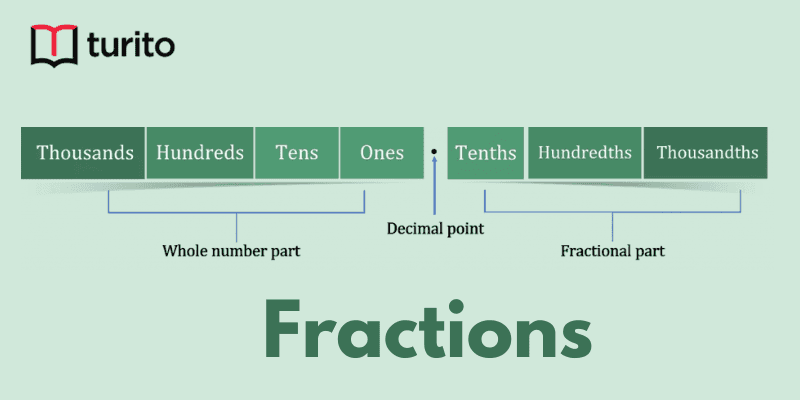
Decimals: A decimal number can be defined as a number whose whole number part and the decimal point separates the fractional part. The dot in a decimal number is called a decimal point.

Read and write tenths in decimal and fractional forms.
Tenths: The first digit to the right of the decimal point is one out of 10 equal parts of a whole.
Example:

Example: 0.6 means six-tenths or 
Decimal form: A decimal is a fraction written in a particular form.
Example:

E.g., Instead of writing 
You can express the fraction as 0.5.
Decimal point: A point used to separate the whole number part from the fractional part of the decimal number.
Example:

Example: 34.9
Here, 34 = Whole number part
9 = Fractional part
. = Decimal
Expanded form: The expanded notation, also called expanded form, for decimals is the same as the integer expanded form. A decimal can be written as the sum of all the place values.
E.g., (a) Write 317.29 in an expanded form.
Sol:

Place value chart:

Example: Write the place value of the digits 2 and 4 in the number 326.471
Sol:

Place value of 2 = Tens = 20
Place value of 4 = Tenths = 0.4
Understanding Hundredths:
Hundredths: Divide one whole into 100 equal parts or one-hundredth. In the decimal form, each part has a value equal to 0.01.
Example: Express the fraction in decimal?

Place holder zero: The zero is called a place holder. It is not worth anything on its own, but it changes the value of other digits.
Look at the number 502.

Sol: 52 = five tens and two units

The zero place-holder is keeping the 5 and 2 in their correct places:

Examples:
(a) Express as a decimal.
Sol:  = 0.05
(b) Express 15 hundredths as decimal.
Sol:  = 0.15
(c) Express 1 as decimal
Sol:

1 = 1 one and 2 tenths 5 hundredths
= 1 one and 25 hundredths
= 1.25
Comparing Decimals:
Compare and order decimals.
Comparing Decimals: Comparing means examining the differences between numbers, quantities, or values to decide if it is greater than, smaller than, or equal to other quantities.
Example: Compare 4.27 and 4.65 using a number line.
Sol:

Example:
(a) Compare 0.6 and 0.8
Sol: 0.6 = 6 tenths
0.8 = 8 tenths
Because 8 tenths > 6 tenths
0.8 > 0.6
(b) Compare 0.317 and 0.341
Sol: 0.317 = 0.3 + 0.01 + 0.007
= 3 tenths + 1 hundredths + 7 thousandths
0.341 = 0.3 + 0.04 + 0.001
= 3 tenths + 4 hundredths + 1 thousandths
3 tenths = 3 tenths
Now, compare the next digit
1 hundredths < 4 hundredths
Thus, 0.317 < 0.341
Ordering: Arranging things in relation to each other according to a particular sequence or a pattern.
Example:
(a) Order 9.34, 83.9, 21.4, 0.96 from smallest to largest.
Sol: 0.96, 9.34, 21.4, 83.9
(b) Order 7.93, 5.94, 0.93, 28.7 from largest to smallest.
Sol: 28.7, 7.93, 5.94, 0.93
Complete number patterns
Number pattern is a pattern or sequence in a series of numbers by using a specific rule or pattern.
Example: (a) Complete the pattern 1.5, 1.9, 2.3, 2.7, 3.1, 3.5, 3.9, ____, ____
Sol:

(b) Find the next two numbers in the pattern 6.8, 6.4, 6, 5.6, 5.2, 4.8, 4.4.
Sol:

What have we learnt:
- Introduction of decimals.
- How the place value of a digit changes when we multiply or divide by ten.
- How to read, write, and model fractions with 10 and 100 in the denominator.
- How to compare decimals from the least to greatest and from the greatest to least.
- Ordering of decimals.
Related topics

Square 1 to 20 : Chart, Table, Perfect Squares and Examples
Square 1 to 20 When you multiply a number by itself, the result is called a square. And when you’re preparing for exams, you need to have a foundation for algebra and quick mental math because you get a really short time to do your exam. Therefore, learning the squares from one to twenty is […]

Square 1 to 40 : Table, Perfect Squares, Chart and Examples
Square 1 to 40 When you multiply a number by itself, the resulting number is a square, and if you are someone who is either appearing in a competitive exam or just wants to do well in math in school, knowing square 1 to 40 is a really important skill. But manually multiplying every time, […]

Square Root : Definition, Formula, Methods and Types Explained
Square Root Square roots are one of those seemingly daunting maths topics that appear in many different situations, from algebra to geometry. Yet the concepts behind them aren’t as hard to grasp. It makes handling numbers far easier if you know the concept well. Let us understand how to find the square roots of a number […]

Cubes 1 to 20 : Chart, Table, Memory Tricks and Examples
Most students don’t struggle much with smaller cubes like 2³ or 3³. Those usually come quickly. The hesitation starts with numbers like 11³ or 17³. Or when someone suddenly asks, what is 20 cubed? That pause is not a memory problem. It’s about the lack of proper understanding and hence confidence. Naturally, learning cubes 1 […]


Other topics



Comments: