



Key Features of Quadratic Function

Key Concepts
- Define quadratic function.
- Define quadratic parent function.
- Draw the graph of 𝑓(𝑥)=𝑎x2.
- Draw the graph of 𝑓(𝑥)=𝑎x2 when 𝑎<0.
- Interpret quadratic functions from the table.
- Compare the rate of change on the graph.
Exponential function
An exponential function is the product of an initial amount and a constant ratio raised to a power.

Transformations of exponential functions
Vertical translation of graphs
Algebra: f(x) = ax+k

Horizontal translation of graphs
Algebra: f(x) = a(x−h)
Polynomial
A polynomial expression is an expression that has constants and variables by means of addition, multiplication, and exponentiation to a non-negative integer power.

Factorizing x2+bx+c = 0
To the factor, a trinomial of the form x2+bx+c, find a factor pair of c that has a sum of b. Then use the factors you found to write the binomials that have a product equal to the trinomial.

Quadratic function
A function f defined by f(x) = ax2+bx+c, where a, b and c are real numbers and a≠0a≠0, is called a quadratic function.

Graph of a quadratic equation
The graph of a quadratic function is a curve called a parabola.

- The axis of symmetry intersects the vertex and divides the parabola in half.
- The vertex is the lowest (or highest) point on the graph of a quadratic function.
Quadratic parent function
The quadratic parent function is f(x) = x2. It is the simplest function in the quadratic function family.
- The quadratic parent function is f(x)=x2
- It is the simplest function in the quadratic function family.

Graph of f(x) = ax2
- For 0<|a|<1, the shape of the parabola is wider than the parent function.
- For |a|>1, the shape of the parabola is narrower than the parent function.

Graph of f(x) = ax2 when a<0
- f(x) = ax2 is the reflection of f(x) = -ax2 over the x-axis.

Compare the rate of change in the graph
- Find the slope of the line that passes through each pair of points.
- For positive intervals, the greater the value of a the greater the average rate of change. In this case, the ratio of the a-values in the two functions is the same as the ratio of the average rates of change.
Exercise
1. How does the value of a in g(x) = -4x2 affect the graph when compared to the graph of the quadratic parent function?
2. In which interval is the function increasing?

3. How does the value of a in h(x) = 0.15x2 affect the graph when compared to the graph of the quadratic parent function?
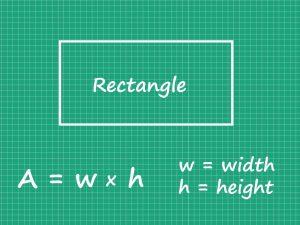
4. Write a quadratic equation for the area of the figure given. Find the area of the figure for the given value of x.
x=5

Concept Map
A function 𝑓 defined by 𝑓(𝑥) = 𝑎𝑥2 + 𝑏𝑥 + 𝑐, where 𝑎, 𝑏, and 𝑐 are real numbers and 𝑎 ≠ 0, is called a quadratic function.
The graph of a quadratic function is a curve called a parabola.

What we have learned
- A function f defined by f(x) = ax2 + bx + c, where a, b, and c are real numbers and a≠0, is called a quadratic function.
Related topics

Square 1 to 20 : Chart, Table, Perfect Squares and Examples
Square 1 to 20 When you multiply a number by itself, the result is called a square. And when you’re preparing for exams, you need to have a foundation for algebra and quick mental math because you get a really short time to do your exam. Therefore, learning the squares from one to twenty is […]

Square 1 to 40 : Table, Perfect Squares, Chart and Examples
Square 1 to 40 When you multiply a number by itself, the resulting number is a square, and if you are someone who is either appearing in a competitive exam or just wants to do well in math in school, knowing square 1 to 40 is a really important skill. But manually multiplying every time, […]

Square Root : Definition, Formula, Methods and Types Explained
Square Root Square roots are one of those seemingly daunting maths topics that appear in many different situations, from algebra to geometry. Yet the concepts behind them aren’t as hard to grasp. It makes handling numbers far easier if you know the concept well. Let us understand how to find the square roots of a number […]

Cubes 1 to 20 : Chart, Table, Memory Tricks and Examples
Most students don’t struggle much with smaller cubes like 2³ or 3³. Those usually come quickly. The hesitation starts with numbers like 11³ or 17³. Or when someone suddenly asks, what is 20 cubed? That pause is not a memory problem. It’s about the lack of proper understanding and hence confidence. Naturally, learning cubes 1 […]


Other topics



Comments: