



Mixed Numbers – Definition with Examples

Learn all about mixed numbers- definitions, examples, operations, and conversions. In mathematics, we use different forms of numbers such as mixed numbers, whole numbers, fractions, and more. In this article, we will cover the following:
- What is a mixed number?
- What are mixed number fractions?
- What is an improper fraction?
- Converting improper fractions to mixed numbers
- Converting mixed numbers to improper fractions
- Operations on mixed numbers: Addition, Subtraction, Multiplication, Division.
What is a Mixed Number?
A mixed number is a form of fraction consisting of a whole number and a proper fraction. It is used to represent a number between any two whole numbers. It is also called a mixed fraction.
Here are a few examples:

Properties of Mixed Numbers
- It is partly a fraction.
- It is partly a whole number.
Real-Life Examples of Mixed Numbers
We can understand mixed fractions by expressing the parts of a whole as mixed fractions. For instance, while serving a pizza at home or a pie.

Some examples from everyday life are
- 2 ¼ Leftover pizzas
- 1 ¾ half-filled glasses of milk
- 1 ½ Piece of watermelon
- 2 ⅓ cups of coffee
- 2 ¾ miles in a race
- 1 ½ banana
What are Mixed Number Fractions?
As already stated, it combines a fraction and a whole number. The fraction consists of a numerator and a denominator. So, a mixed number is partly a fraction and partly a whole number.

What are Improper Fractions?
A fraction whose numerator is greater than the denominator is an improper fraction. Some examples of improper fractions are:
8/7, 6/4, 11/5
How to Convert Improper Fraction to Mixed Numbers?
To convert improper fractions to mixed numbers, follow the steps given below:
- Firstly, we have to divide the numerator by the denominator.
- Next, we will write it in the mixed number form by placing the quotient as the whole number. The remainder becomes the numerator and the divisor the denominator.
The following example will help you understand this better:
| Question 1: Convert 12/5 into a mixed fraction. Solution: To convert 12/5 into a mixed number, we will divide 12 by 5 When dividing 12/5, we get 2 as the quotient and 2 as the remainder. The quotient 2 will become the whole number, the remainder 2 will be the numerator, and the divisor 5 will be the denominator. ∴ 12/5 = 2 |
How to Convert Mixed Number to Improper Fractions?
To rewrite to an improper fraction format, follow the steps given below:
- Multiply the denominator and the whole number to obtain a product.
- Now add the numerator to the product.
- The sum will be your numerator of the improper fraction.
- The denominator of the improper fraction will be the same as the denominator of the mixed number.
The following example illustrates the steps mentioned above:
| Question 2: Convert 3 5/4 into an improper fraction. Solution: To convert a mixed number to an improper fraction, we will multiply the denominator 4 with the whole number 3. = 3 x 4=12 Now we will add the numerator 5 to the sum 12 = 5+12 = 17 So, the fraction will be 17/4 |
Operations on Mixed Numbers
Here is how we can perform basic operations on mixed numbers, including addition, subtraction, multiplication, and division.
Addition of Mixed Numbers
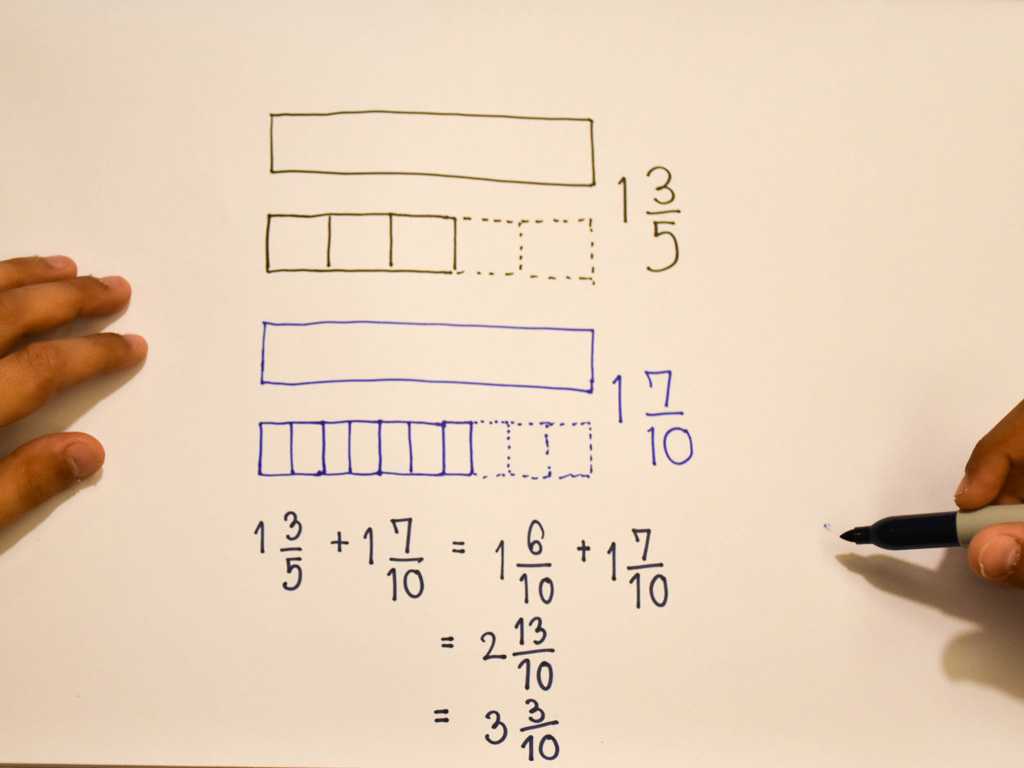
We can add this with the same denominators as well as the ones with different denominators. The following examples will help you understand the stepwise method to add the mixed numbers with the same or different denominators.
Note: Before applying any arithmetic operations such as subtraction, addition, multiplication, or division, we must change the mixed fractions to improper fractions. So, the operations will be on the improper fractions.
Adding Mixed Numbers with Same Denominators
Add: 2 2/4 + 5 1/4
Step 1: Firstly, we will convert the mixed numbers into improper fractions. Here we will have 10/4 and 21/4. Now keeping the denominator of the fractions the same, i.e., 4. We will add the two numbers.
Step 2: Add the numerators of the fractions. In this case, it will be 10+21=31.
Step 3: Now, the answer you have is in the form of an improper fraction. In that case, the mixed fraction 31/4 will be 734.
Adding Mixed Numbers with Different Denominators
Add: 4 3/2 + 3 4/5
Step 1: We will convert the mixed number into an improper fraction format. The two fractions will be 11/2 and 19/5
Step 2: Calculate the LCM of the denominators. The LCM of 2 and 5 will be 10.
Step 3: In the next step, we will multiply denominators and numerators of both fractions with a number such that the LCM is their new denominator. That is 11/2 by 5 and 19/5 by 2.
Step 4: Now add the new numerator while keeping the same denominator. That is 55/10 + 38/10 = 93/10
Step 5: Your answer will be in the form of an improper fraction. Change it into a mixed fraction. So, the answer will be 9
Subtraction of Mixed Numbers
We can subtract the mixed numbers with the same denominators and the ones with different denominators. The following examples will help you understand the stepwise method to subtract the mixed numbers with the same or different denominators.
Here’s a stepwise explanation of how to subtract the mixed fraction with the same or different denominators.
Subtracting With the Same Denominators
Example: 5 2/4 – 3 1/4
Step 1: Convert the mixed number into an improper fraction. Here it will be 22/4 and 13/4. We will keep the denominator ‘4’ the same.
Step 2: Now subtract the numerators 22-13 = 9.
Step 3: Now, the obtained fraction 9/4 is an improper fraction. We will convert it into the mixed fraction, i.e., 1 5/4
Subtracting Mixed Numbers with Different Denominators
Subtract 1 4/8 – 1 2/6
Step 1: We will convert the mixed number into an improper fraction form. Here it will be 12/8 and 8/6. Now, we find the LCM of the denominators. The LCM of 8 and 6 is 24.
Step 2: Now, we will multiply the denominators and numerators of the two fractions with a number to have the LCM as their new denominator. We will multiply the numerator 8/6 by 4 and 12/8 by 3.
Step 3: Next, we will subtract the numerators while keeping the denominators the same. So, 36 / 24 – 32/24 will give 4/24
Step 4: Since the obtained answer can be simplified, we will reduce 4/24 to 1/6.
Multiplication of Mixed Fractions
We can multiply the mixed fractions too. Irrespective of their denominators, it can be multiplied as follows.
Example: Multiply 4 2/5 and 2 2/4
Step 1: We will convert the given mixed fraction into an improper fraction. The fractions will be 22/5 and 10/4.
Step 2: Now, we will multiply the numerators of both fractions together and multiply the denominators of both fractions in a similar way. So, 22 × 10 and 5 × 4 will give 220 and 20, respectively.
Step 3: The fraction will be 220/20. We can reduce this fraction into the simplest form 11.
Division of Mixed Fractions
We can divide the mixed fractions as follows:
Example: Divide 6 1/2 by 2 1/4
Step 1: We will convert the given mixed fraction into an improper fraction. The fractions will be 13/2 and 9/4.
Step 2: Now, the new division problem will be 13/2 ÷ 9/4.
Step 3: Next, we will take the reciprocal of the second fraction, i.e., we will flip it 13/2*4/9.
Step 4: We will multiply the two numerators and the denominators separately. So, we will get 52 on multiplying 13 and 4. Denominators will give 18 as the product of 2 and 9.
Step 5: The new fraction will be 52/18.
Step 6: On simplifying the fraction 52/18, we will get 26/9.
Step 7: 26/9 is an improper fraction. We will convert it into a mixed number. The answer will be 2 8/9.

Frequently Asked Questions?
1. How do you calculate a mixed number in the simplest form?
To calculate in the simplest form, you first need to convert the fractional part of the number into an improper fraction. To do this, divide the whole number part of the mixed number by the denominator of the fractional part. Then multiply this result by the numerator of the fractional part and add it to both sides of your equation. This will give you:
Whole number – numerator + denominator
Then simplify each side of your equation by dividing both by 2 and adding a 1 to each side:
Whole number – numerator + denominator + 2 = whole number – 1
Finally, divide both sides by 2 again to get rid of any fractions:
Whole number – numerator + numerator = whole number.
2. How do you calculate mixed numbers?
To calculate mixed numbers, you simply add the whole number to the fractional part. For example, let’s say you have 4 1/3 apples. You can just add 4 + 1/3 and get 5 1/3 apples. If you had 5 2/3 apples, you’d add 5 + 2/3 and get 7 2/3 apples.
Mixing numbers is a great way to estimate answers without having to use decimals or fractions. It also helps students who are still learning how to add fractions by breaking down larger numbers into smaller ones that are easier to work with.
3. Is a mixed number always greater than a whole number?
No, a mixed number can be less than or equal to a whole number.
Mixed numbers are the sum of an integer and a proper fraction. This means that the integer portion represents the whole part, while the fractional portion of the number represents the part of it that is not whole. This means that a mixed number can be less than or equal to a whole number if its integer portion is smaller than or equal to the whole number’s integer portion, but its fractional part is greater than 1/2 (0.5).
4. How do you simplify a mixed number?
Simplifying it is actually an easy process. Let’s say you want to simplify 3/4. All you have to do is find the sum of the whole number and the fraction, then divide that sum by two. So in this case:
3 + 4 = 7
7/2 = 3.5
So our simplified form of 3/4 is 3 ½
5. How to turn a mixed number into the simplest form?
There are two ways to turn into the simplest form:
First, we can write the whole number part as an integer and then add the fractional part. For example, if we start with 3 1/2 and want to turn it into the simplest form, we would write 3 as an integer (3), and then add 1/2 as a fraction (1/2). So our answer is 4 1/2.
Alternatively, if your numbers are already in their simplest form, you can use a ratio to find the whole number portion of your mixed number. For example, if you start with 7 3/8 and want to turn it into the simplest form, you would divide 7 by 8 to get a ratio of 0.875. This means that there are 8 parts in 7 parts of 7 3/8—which means that there is 1 part left over! So our answer is 6 3/8
Related topics

Square 1 to 20 : Chart, Table, Perfect Squares and Examples
Square 1 to 20 When you multiply a number by itself, the result is called a square. And when you’re preparing for exams, you need to have a foundation for algebra and quick mental math because you get a really short time to do your exam. Therefore, learning the squares from one to twenty is […]

Square 1 to 40 : Table, Perfect Squares, Chart and Examples
Square 1 to 40 When you multiply a number by itself, the resulting number is a square, and if you are someone who is either appearing in a competitive exam or just wants to do well in math in school, knowing square 1 to 40 is a really important skill. But manually multiplying every time, […]

Square Root : Definition, Formula, Methods and Types Explained
Square Root Square roots are one of those seemingly daunting maths topics that appear in many different situations, from algebra to geometry. Yet the concepts behind them aren’t as hard to grasp. It makes handling numbers far easier if you know the concept well. Let us understand how to find the square roots of a number […]

Cubes 1 to 20 : Chart, Table, Memory Tricks and Examples
Most students don’t struggle much with smaller cubes like 2³ or 3³. Those usually come quickly. The hesitation starts with numbers like 11³ or 17³. Or when someone suddenly asks, what is 20 cubed? That pause is not a memory problem. It’s about the lack of proper understanding and hence confidence. Naturally, learning cubes 1 […]


Other topics



Comments: