



Postulates

Key Concepts
- Use postulates involving points, lines and planes.
- Identify postulates from a diagram.
- Interpret a diagram in three dimensions.
Point, Line and Plane Postulates
POSTULATE 5: Through any two points, there exists exactly one line.
POSTULATE 6: A line contains at least two points.
POSTULATE 7: If two lines intersect, then their intersection is exactly one point.
POSTULATE 8: Through any three non-collinear points, there exists exactly one plane.
POSTULATE 9: A plane contains at least three non-collinear points.

POSTULATE 10: If two points lie in a plane, then the line containing them lies in the plane.
POSTULATE 11: If two planes intersect, then their intersection is a line.
Concept Summary


Perpendicular Figures
A line is a line perpendicular to a plane if and only if the line intersects the plane at a point and is perpendicular to every line in the plane that intersects it at that point.
In a diagram, a line perpendicular to a plane must be marked with a right-angle symbol.

Let’s solve some examples!
Identify a postulate illustrated by a diagram
Example 1:
State the postulate illustrated by the diagram.


Solution:
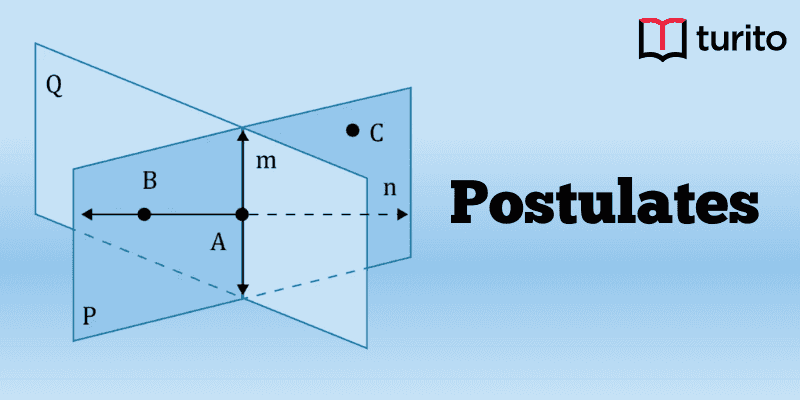
- Postulate 7: If two lines intersect, then their intersection is exactly one point.
- Postulate 11: If two planes intersect, then their intersection is a line.
Identify postulates from a diagram
Example 2:
Use the diagram to write examples of postulates 9 and 10.

Solution:
Postulate 9: Plane P contains at least three non-collinear points, A, B, and C.
Postulate 10: Point A and point B lie in plane P, so line n containing A and B also lies in plane P.
2.3 Use the given information to sketch a diagram
Example 3:

Interpret a diagram in three dimensions
Example 4:

Questions to Solve
Question 1:
State the postulate illustrated by the diagram.

Solution:
- Postulate 5: If there are two points, there exists exactly one line passing through them.
- Postulate 9: If there is a plane, then there are at least three non-collinear points in that plane.
Question 2:
Use the pyramid to write examples of the postulate indicated.

Solution:
- Postulate 5: Only one line SZ passes through the points S and Z.
- Postulate 7: Lines SZ and ZU intersect at only one point Z.
- Postulate 9: Plane formed by the front of this pyramid (it will be called plane STU) contains at least three non-collinear points S, T and U.
- Postulate 10: Points Z and U lie in the plane STU, so the line ZU also lies in plane P.
Question 3:
Decide whether the statement is true or false. If it is false, give a real-world counterexample.
- Through any three points, there exists exactly one line.
- A point can be in more than one plane.
- Any two planes intersect.
Solution:
- False
- Counterexample: If these three points are non-collinear, then one line cannot pass through these three points.
True
False
- Counterexample: If the two planes are parallel, they will never intersect.
Key Concepts Covered
Point, line, and plane postulates
POSTULATE 5: Through any two points, there exists exactly one line.
POSTULATE 6: A line contains at least two points.
POSTULATE 7: If two lines intersect, then their intersection is exactly one point.
POSTULATE 8: Through any three noncollinear points there exists exactly one plane.
POSTULATE 9: A plane contains at least three noncollinear points.
POSTULATE 10: If two points lie in a plane, then the line containing them lies in the plane.
POSTULATE 11: If two planes intersect, then their intersection is a line
Exercise
- In triangle ABC, AD is a median. If the area of ΔABD is 15 cm sq, then find the area of ΔABC.
- ABCD is a parallelogram and BPC is a triangle with P falling on AD. If the area of parallelogram ABCD= 26 cm2, find the area of triangle BPC.
- PQRS is a parallelogram and PQT is a triangle with T falling on RS. If area of triangle
PQT = 18 cm2, then find the area of parallelogram PQRS. - ABCD is a parallelogram where E is a point on AD. Area of ΔBCE = 21 cm2. If CD = 6 cm, then find the length of AF.
- The area of triangle ABC is 15 cm sq. If ΔABC and a parallelogram ABPD are on the same base and between the same parallel lines then what is the area of parallelogram ABPD.
- The area of parallelogram PQRS is 88 cm sq. A perpendicular from S is drawn to intersect PQ at M. If SM = 8 cm, then find the length of PQ.
- Amy needs to order a shade for a triangular-shaped window that has a base of 6 feet and a height of 4 feet. What is the area of the shade?
- Monica has a triangular piece of fabric. The height of the triangle is 15 inches and the triangle’s base is 6 inches. Monica says that the area of the fabric is 90 square inches. What error did Monica make? Explain your answer.
- The sixth-grade art students are making a mosaic using tiles in the shape of right triangle. The two sides that meet to form a right angle are 3 centimeters and 5 centimeters long.
If there are 200 tiles in the mosaic, what is the area of the mosaic? - A parallelogram with area 301 has a base of 35. What is its height?
Related topics

Square 1 to 20 : Chart, Table, Perfect Squares and Examples
Square 1 to 20 When you multiply a number by itself, the result is called a square. And when you’re preparing for exams, you need to have a foundation for algebra and quick mental math because you get a really short time to do your exam. Therefore, learning the squares from one to twenty is […]

Square 1 to 40 : Table, Perfect Squares, Chart and Examples
Square 1 to 40 When you multiply a number by itself, the resulting number is a square, and if you are someone who is either appearing in a competitive exam or just wants to do well in math in school, knowing square 1 to 40 is a really important skill. But manually multiplying every time, […]

Square Root : Definition, Formula, Methods and Types Explained
Square Root Square roots are one of those seemingly daunting maths topics that appear in many different situations, from algebra to geometry. Yet the concepts behind them aren’t as hard to grasp. It makes handling numbers far easier if you know the concept well. Let us understand how to find the square roots of a number […]

Cubes 1 to 20 : Chart, Table, Memory Tricks and Examples
Most students don’t struggle much with smaller cubes like 2³ or 3³. Those usually come quickly. The hesitation starts with numbers like 11³ or 17³. Or when someone suddenly asks, what is 20 cubed? That pause is not a memory problem. It’s about the lack of proper understanding and hence confidence. Naturally, learning cubes 1 […]


Other topics





Comments: