



Properties of Trapezoids

Key Concepts
- Define a trapezoid.
- Explain the properties of a trapezoid.
- Solve problems based on properties of a kite.
Trapezoid
A quadrilateral having only one pair of parallel sides is called a trapezoid.

- A trapezium in which the non-parallel sides are equal is an isosceles trapezium.

Property of a trapezoid related to base angles
Theorem 1:
In an isosceles trapezoid, each pair of base angles is congruent.

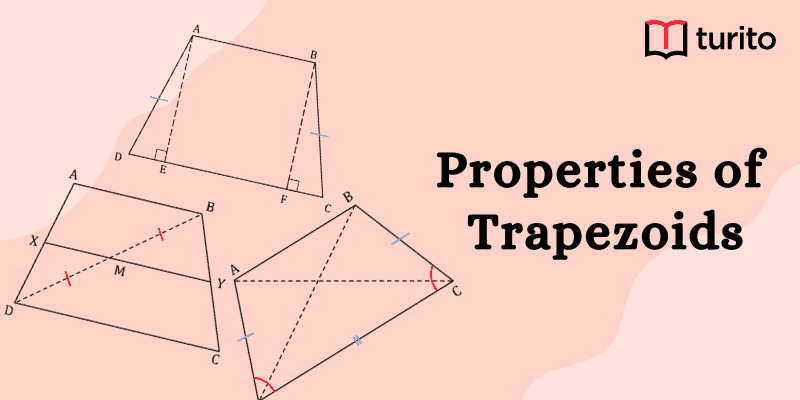
Given: ABCD is a trapezoid where AB∥CD.
To prove: ∠ADC = ∠BCD and ∠BAD = ∠ABC
Proof:

Draw perpendicular lines AE and BF between the parallel sides of the trapezoid.
In ΔAED and ΔBFC,
AD = BC [Isosceles trapezoid]
AE = BF [Distance between parallel lines will always be equal]
∠AEB = ∠BFC=90° [AEꞱCD and BFꞱCD]
If two right-angled triangles have their hypotenuses equal in length and a pair of shorter sides are equal in length, then the triangles are congruent.
∴ ΔAED ≌ ΔBFC [RHS congruence rule]
We know that the corresponding parts of congruent triangles are equal.
Hence, ∠ADC = ∠BCD
And ∠EAD = ∠FBC
Now, ∠BAD = ∠BAE + ∠EAD
∠BAD = 90° + ∠EAD
∠BAD = 90° + ∠EAD
∠BAD = ∠ABC
Hence, each pair of base angles of an isosceles trapezoid is congruent.
Property of trapezoid related to the length of diagonals
Theorem 2:
The diagonals of an isosceles trapezoid are congruent.

Given: In trapezoid ABCD, AB∥CD, and AD = BC
To prove: AC = BD
Proof:
In ΔADC and ΔBCD,
AD = BC [Isosceles trapezoid]
∠ADC = ∠BCD [Base angles of isosceles trapezoid]
CD = CD [Common]
Therefore, ΔAED ≌ ΔBFC [SAS congruence rule]
We know that the corresponding parts of congruent triangles are equal.
So, AC = BD
Hence, the diagonals of an isosceles trapezoid are congruent.
Property of trapezoid related to the length of diagonals
Theorem 3:
In a trapezoid, the midsegment is parallel to the bases, and the length of the midsegment is half the sum of the lengths of the bases.

Given: In trapezoid ABCD, AB∥CD, and X is the midpoint of AD, Y is the midpoint of BC.
To prove: XY = 1/2 × (AB+CD)
Proof: Construct BD such that the midpoint of BD passes through XY.
In ΔADB, X is the midpoint of AD, and M is the midpoint of DB.
So, XM is the midsegment of ΔADB.
We know that a line segment joining the midpoints of two sides of the triangle is parallel to the third side and has a length equal to half the length of the third side. [Midsegment theorem]
∴ XM ∥ AB and XM = 1/2 × AB …(1)
In ΔBCD, Y is the midpoint of BC and M is the midpoint of BD.
So, MY is the midsegment of ΔBCD.
∴ MY ∥ CD and MY = 1/2 × CD …(2) [Midsegment theorem]
Since XM ∥ AB and MY ∥ CD, so, XY
Now, XY=XM+MY
= 1/2 × AB + 1/2 × CD
XY = 1/2 × (AB+CD)
Kite
A kite is a quadrilateral whose four sides can be grouped into two pairs of equal-length sides that are adjacent to each other.
(or)
A parallelogram also has two pairs of equal-length sides, but they are opposite each other in a kite.

- Only one diagonal of a kite bisects the other diagonal.
Property of kite related to the angle between the diagonals
Theorem:
The diagonals of a kite are perpendicular.

Given: In kite WXYZ, XY=YZ, WX=ZW
To prove: XZ Ʇ WY
Proof: Draw diagonals XZ and WY. Let the diagonals intersect at O.
In ΔWXY and ΔWZY,
WX=WZ [Adjacent sides of kite]
XY=ZY [Adjacent sides of kite]
WY=YW [Reflexive property]
∴ ΔWXY ≌ ΔWZY [SSS congruence rule]
We know that the corresponding parts of congruent triangles are equal.
So, ∠XYW= ∠ZYW …(1)
In ΔOXY and ΔOZY,
XY=ZY [Adjacent sides of kite]
OY=YO [Reflexive property]
∠XYW= ∠ZYW [from (1)]
∴ ΔOXY ≌ ΔOZY [SAS congruence rule]
So, ∠YOX = ∠YOZ [CPCT]
But ∠YOX+∠YOZ = 180°
2∠YOX = 180°
∠YOX = 90°
Hence, the diagonals of a kite are perpendicular.
Exercise
- Find the value of k if STUV is a trapezoid.

- If EFGH is an isosceles trapezoid, find the value of p.

- Find the length of PQ if LMQP is a trapezoid and O is the midpoint of LP and N is the midpoint of MQ.

- What must be the value of m if JKLM is a kite?

- If WXYZ is a kite, find the length of diagonal XZ.

Concept Map

What we have learned
- A quadrilateral having only one pair of parallel sides is called a trapezoid.
- A kite is a quadrilateral whose four sides can be grouped into two pairs of equal-length sides that are adjacent to each other.
Related topics

Square 1 to 20 : Chart, Table, Perfect Squares and Examples
Square 1 to 20 When you multiply a number by itself, the result is called a square. And when you’re preparing for exams, you need to have a foundation for algebra and quick mental math because you get a really short time to do your exam. Therefore, learning the squares from one to twenty is […]

Square 1 to 40 : Table, Perfect Squares, Chart and Examples
Square 1 to 40 When you multiply a number by itself, the resulting number is a square, and if you are someone who is either appearing in a competitive exam or just wants to do well in math in school, knowing square 1 to 40 is a really important skill. But manually multiplying every time, […]

Square Root : Definition, Formula, Methods and Types Explained
Square Root Square roots are one of those seemingly daunting maths topics that appear in many different situations, from algebra to geometry. Yet the concepts behind them aren’t as hard to grasp. It makes handling numbers far easier if you know the concept well. Let us understand how to find the square roots of a number […]

Cubes 1 to 20 : Chart, Table, Memory Tricks and Examples
Most students don’t struggle much with smaller cubes like 2³ or 3³. Those usually come quickly. The hesitation starts with numbers like 11³ or 17³. Or when someone suddenly asks, what is 20 cubed? That pause is not a memory problem. It’s about the lack of proper understanding and hence confidence. Naturally, learning cubes 1 […]


Other topics



Comments: