



Proportionality Theorem

Key Concepts
- Proportionality theorem for triangles
- Use of proportionality theorem for triangles
- Converse of Proportionality theorem for triangles
- Use of the converse of proportionality theorem of triangles
Different Postulates of Similarity of Triangles
Angle-Angle (AA) Similarity Postulate
If two angles of one triangle are congruent to two angles of another triangle, then the two triangles are similar.
Side Side Side (SSS) Similarity Postulate
If the corresponding side lengths of two triangles are proportional, then the triangles are similar.
Side Angle Side (SAS) Similarity Postulate
If an angle of one triangle is congruent to an angle of a second triangle and the lengths of the sides, including these angles, are proportional, then the triangles are similar.
Triangle Proportionality Theorem
If a line parallel to one side of a triangle intersects the other two sides, then it divides the two sides proportionally.
Proof:

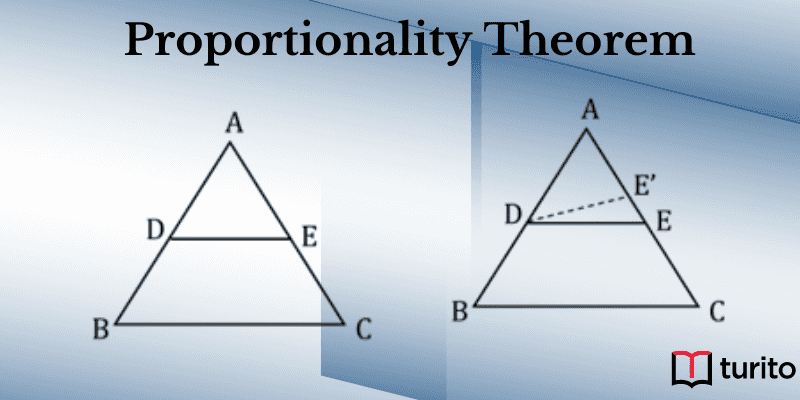
In the triangle ABC, in which DE is drawn parallel to BC. Point D lies in BA, and E is in BC.
Prove


∠BAC = ∠BDE (Corresponding angles)
∠BCA = ∠BED (Corresponding angles)
∠B is common
Then by AA similarity postulate
Triangle BAC is similar to triangle BDE.

(Corresponding sides of similar triangles are proportional)

(Subtracting 1 from both sides)

Hence proved.
- In ΔABC, D and E are points on the sides AB and AC, respectively, such that DE || BC
If

and AC = 15 cm. find AE.


(Proportionality theorem for triangles)

15 – AE = 5AE
6AE = 15
AE = 15/6
= 5/2 = 2.5
AE = 2.5 cm
- Use the proportionality theorem of triangles to find the value of x.
DE || BC, D is a point on side AB of triangle ABC, and E is a point on side AC of triangle ABC.


5(9 – x) = 4x
45 – 5x = 4x
45 = 4x + 5x
45 = 9x
x =

= 5
Converse of Triangle Proportionality Theorem

If a line divides two sides of a triangle proportionally, then it is parallel to the third side.
Proof
A triangle ABC and line DE intersects AB at D and AC at E such that,

To Prove: DE is parallel to BC
Assume that DE is not parallel to BC.
Draw a line DE’ parallel to BC.
Then by Basic Proportionality Theorem, DE’ || BC,

But


Adding 1 on both sides

But EC = E’C is possible only if E and E’ coincide. i.e., DE and DE’ are the same line.
DE || BC,
Hence proved.

- If D and E are the points on the sides AB and AC of a triangle ABC, respectively, such that AD = 6 cm, BD = 9 cm, AE = 8 cm, and EC = 12 cm. Show that DE is parallel to BC.
By the converse proportionality theorem of triangles, DE will be parallel to BC if


Therefore, DE is parallel to BC.
Theorem

If three parallel lines intersect two transversals, then they divide the transversals proportionally.
Three lines k1, k2, k3 such that k1 || k2 || k3. Two transversals, t1 and t2, intersect at k1, k2, k3 at points A, B, C, D, E, F.
To prove

CONSTRUCTION: Draw an auxiliary line through the points A and D, and it intersects k2 at M.
Proof
Consider the triangle ADF, then

(By proportionality theorem of triangles) ———(1)
Consider the triangle ADC, then

(By proportionality theorem of triangles) ———(2)
or

(Reciprocal property of proportions) ———–(3)
From (1) and (3)

Hence proved.
Theorem

If a ray bisects an angle of a triangle, then it divides the opposite side into segments whose lengths are proportional to the lengths of the other two sides.
To prove
Given ∠YXW = ∠WXZ
CONSTRUCTION
Draw a line AZ parallel to the bisector XW. Extend segment XY to meet AZ.
Proof
Given ∠YXW = ∠WXZ
∠WXZ = ∠XZA (Alternate interior angles are equal since XW || AZ)
∠WXZ = ∠XAZ (Corresponding angles are equal since XW || AZ)
Therefore, base angles are equal.
Then AX=XZ
In triangle YAZ, XW || AZ, then by proportionality theorem of triangles,

But AX= XZ

Hence proved.
- Find the value of x.


If a ray bisects an angle of a triangle, then it divides the opposite side into segments whose lengths are proportional to the lengths of the other two sides.

x= 10
Exercise
- Use proportionality theorem for finding the missing length.

- Solve for x using proportionality theorem for triangles.

- Find the missing length.


- ABCD is a trapezium with AB parallel to DC, P and Q are points on non-parallel sides AD and BC, respectively, such that PQ parallel to AB Show that.

- n the given figure shows quadrilateral ABCD in which AB is parallel to DC,
OA = 3x – 19, OB = x – 3, OC = x – 5 and OD = 3 find the value of x. - If the bisector of an angle of a triangle bisects the opposite side, prove that the triangle is isosceles.
- In the given figure PS/SQ = PT/TR and PST = PRQ.

Prove that PQR is an isosceles triangle.
- In the given figure, XY is parallel to MN if
a. LX = 4cm, XM = 6cm and LN = 12.5 cm. find LY
b. LX : XM = 3:5 and LY = 3.6 cm. Find LN
Concept Map

What we have learnt
- Proportionality Theorem for Triangles
If a line parallel to one side of a triangle intersects the other two sides, then it divides the two sides proportionally.
- Converse of Proportionality Theorem for Triangles
If a line divides two sides of a triangle proportionally, then it is parallel to the third side.
- Theorem
If three parallel lines intersect two transversals, then they divide the transversals proportionally.
- Theorem based on angle bisection
If a ray bisects an angle of a triangle, then it divides the opposite side into segments whose lengths are proportional to the lengths of the other two sides.
Related topics

Square 1 to 20 : Chart, Table, Perfect Squares and Examples
Square 1 to 20 When you multiply a number by itself, the result is called a square. And when you’re preparing for exams, you need to have a foundation for algebra and quick mental math because you get a really short time to do your exam. Therefore, learning the squares from one to twenty is […]

Square 1 to 40 : Table, Perfect Squares, Chart and Examples
Square 1 to 40 When you multiply a number by itself, the resulting number is a square, and if you are someone who is either appearing in a competitive exam or just wants to do well in math in school, knowing square 1 to 40 is a really important skill. But manually multiplying every time, […]

Square Root : Definition, Formula, Methods and Types Explained
Square Root Square roots are one of those seemingly daunting maths topics that appear in many different situations, from algebra to geometry. Yet the concepts behind them aren’t as hard to grasp. It makes handling numbers far easier if you know the concept well. Let us understand how to find the square roots of a number […]

Cubes 1 to 20 : Chart, Table, Memory Tricks and Examples
Most students don’t struggle much with smaller cubes like 2³ or 3³. Those usually come quickly. The hesitation starts with numbers like 11³ or 17³. Or when someone suddenly asks, what is 20 cubed? That pause is not a memory problem. It’s about the lack of proper understanding and hence confidence. Naturally, learning cubes 1 […]


Other topics



Comments: