



Pythagoras Theorem – Concept and Its Explanation

Key Concepts
- In a right-angled triangle, the square of the hypotenuse side is equal to the sum of squares of the other two sides.
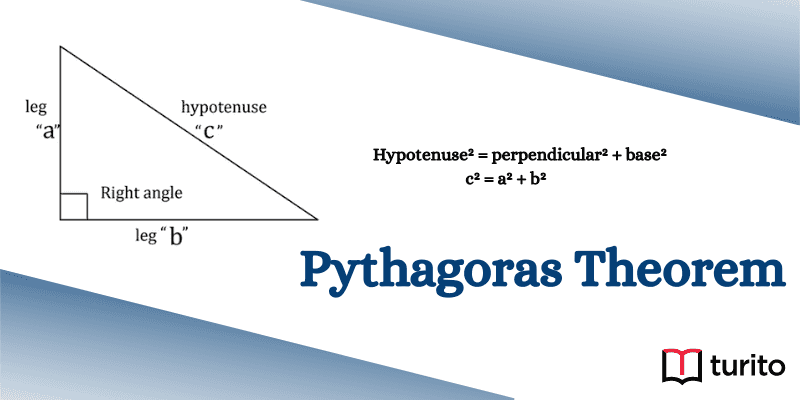
Hypotenuse² = perpendicular² + base²
c2 = a2 + b2 - The Pythagorean theorem is only applicable to the right-angled triangle.
Introduction:
Let us start our topic with a story. One day Raj was on his way home from work. He got an emergency call while he was traveling. He needs to drive 5 km towards the west and 12 km towards the north. Can we find the shortest distance he can cover to reach his home early?
Yes, of course!
Let us understand this scenario by drawing a simple diagram.
Consider Raj’s office is at point A. Given that he travels 5 km towards the west. Let us consider this point as B. After reaching point B, he travels 12 km towards the north. Assume this point as C.

Now, what do you observe? The initial point is A, and the destination point is C.

So, the distance between A and C will be the shortest distance. But how can we calculate this distance?
This is the scenario where the Pythagoras theorem is used. What is Pythagoras theorem? What are its applications? Let us go through all these questions one by one.
The Pythagoras theorem can be stated as follows,
“For a right-angled triangle with squares constructed on each of its sides, the sum of the areas of the two smaller squares is equal to the area of the bigger square.

In the diagram, a, b and c are the side lengths of squares A, B, and C, respectively. Pythagoras’ theorem states that area A + area B = area C, or a2 + b2 = c2.
Pythagoras Theorem
Pythagoras theorem states that “In a right-angled triangle, the square of the hypotenuse side is equal to the sum of squares of the other two sides“.
If we consider the above right-angled triangle,

a is called perpendicular/leg,
b is the base and
c is the hypotenuse.
The longest side of the right-angled triangle is called the hypotenuse.
The hypotenuse is opposite to the right angle.
According to the statement, Pythagoras formula is written as
Hypotenuse² = perpendicular² + base²
i.e., c² = a² + b²
Pythagoras Theorem Proof:
Statement: Pythagoras theorem states that “In a right-angled triangle, the square of the hypotenuse side is equal to the sum of squares of the other two sides”.
Proof: A right-angled triangle ABC, right-angled at B.
To prove- AC² = AB² + BC²
Construction: Draw a perpendicular BD meeting AC at D.

We know, △ADB ~ △ABC
Therefore, AD/AB = AB/AC (corresponding sides of similar triangles)
Or, AB² = AD × AC ……………………………..……..(1)
Also, △BDC ~△ABC
Therefore, CD/BC = BC/AC (corresponding sides of similar triangles)
Or, BC² = CD × AC ……………………………………..(2)
Adding the equations (1) and (2) we get,
AB²+ BC² = AD × AC + CD × AC
AB² + BC² = AC (AD + CD)
Since, AD + CD = AC
Therefore, AC² = AB² + BC²
Hence, the Pythagorean theorem is proved.
Now let us solve the above problem using the Pythagoras theorem.

Here we know that a = 12 km and b = 5 km.
Let us substitute these values in the formula.
c² = a²+ b²
c² = 122 + 52 = 144 + 25 = 169
=> c² = 169
=> c² = 13 x 13
=> c = 13
Exercise:
- A 6 m wide ladder rests against a wall. The lower part of the ladder is 7 m from the base of the area where the wall meets the floor. At what height is the top of the ladder from the floor against the wall?
- The side of a triangle is 8 units, and the hypotenuse is 17 units. Find the other leg of the triangle.
- The two legs of a triangle are given as 5, 12. Find the hypotenuse.
What we have learnt:

- In a right-angled triangle, the square of the hypotenuse side is equal to the sum of squares of the other two sides.
Hypotenuse² = perpendicular² + base²
c² = a² + b² - The Pythagorean theorem is only applicable to the right-angled triangle.
- The longest side of the right-angled triangle is called the hypotenuse.
- The sides opposite the hypotenuse are called legs.
Related topics

Square 1 to 20 : Chart, Table, Perfect Squares and Examples
Square 1 to 20 When you multiply a number by itself, the result is called a square. And when you’re preparing for exams, you need to have a foundation for algebra and quick mental math because you get a really short time to do your exam. Therefore, learning the squares from one to twenty is […]

Square 1 to 40 : Table, Perfect Squares, Chart and Examples
Square 1 to 40 When you multiply a number by itself, the resulting number is a square, and if you are someone who is either appearing in a competitive exam or just wants to do well in math in school, knowing square 1 to 40 is a really important skill. But manually multiplying every time, […]

Square Root : Definition, Formula, Methods and Types Explained
Square Root Square roots are one of those seemingly daunting maths topics that appear in many different situations, from algebra to geometry. Yet the concepts behind them aren’t as hard to grasp. It makes handling numbers far easier if you know the concept well. Let us understand how to find the square roots of a number […]

Cubes 1 to 20 : Chart, Table, Memory Tricks and Examples
Most students don’t struggle much with smaller cubes like 2³ or 3³. Those usually come quickly. The hesitation starts with numbers like 11³ or 17³. Or when someone suddenly asks, what is 20 cubed? That pause is not a memory problem. It’s about the lack of proper understanding and hence confidence. Naturally, learning cubes 1 […]


Other topics



Comments: