



Pythagorean Theorem

Key Concepts
- Find the length of a hypotenuse
- Verify right triangles
The Pythagorean Theorem
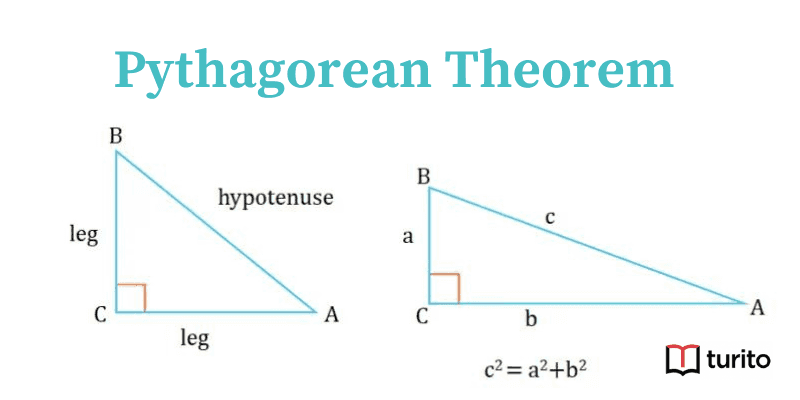
In a right triangle, the square of the length of the hypotenuse is equal to the sum of the squares of the lengths of the legs.

Find the length of a hypotenuse
Hypotenuse: A hypotenuse is the longest side of a right-angled triangle, the side opposite the right angle.
The length of the hypotenuse can be found using the Pythagorean theorem, which states that the square of the length of the hypotenuse equals the sum of the squares of the lengths of the other two sides.
Example 1:
Find the length of the hypotenuse of the right triangle.


Solution:
(hypotenuse)2 = (leg)2 + (leg)2 (Pythagorean Theorem)
x2 = 62 +42 (Substitute)
x2 =36 +16 (Multiply)
x2 = 52 (Add)
x = (52 )1/2 (Radical form)
Example 2:
Ria ties an apple balloon to a stake in the ground. The rope is 10 feet long. As the wind picks up, Ria observes that the balloon is now 6 feet away from the stake. How far above the ground is the balloon now?

Solution:
(Length of rope)2 = (Distance from stake)2 + (Height of rope)2
102 = 62 + x 2 (Substitute)
100 = 36 + x 2 (Multiply)
64 = x 2 (Subtract 64 from each side)
√64 = x (Find positive square root)
8 = x
The balloon is 8 ft above the ground.
Example 3:
Find the area of the isosceles triangle with side lengths 30 ft., 18 ft., and 18 ft.
Solution:
STEP 1:
Draw a sketch. By definition, the length of an altitude is the height of a triangle. In an isosceles triangle, the altitude to the base is also a perpendicular bisector. So, the altitude divides the triangle into two right triangles with the dimensions shown.

STEP 2:
Use the Pythagorean Theorem to find the height of the triangle.
C2 = a2 + b2 (Pythagorean Theorem)
182 = 152 + h2 (Substitute)
324 = 225 + h2 (Multiply)
99 = h2 (Subtract 225 from each side)
9.9=h
STEP 3:
Find the area.
Area = 1/2 (base) (height)
= 1/2 (30) (9.9)
= 148.1 ft. 2
EXAMPLE 3:
Find the length of the hypotenuse of the right triangle.

Solution:
Method 1:
Use a Pythagorean triple.
A common Pythagorean triple is 3, 4 , 5.
Notice that if you multiply the lengths of the legs of the Pythagorean triple by 3, you get the lengths of the legs of this triangle:
3 × 3 = 9 and
4 × 3 =12
So, the length of the hypotenuse is
5 × 3 = 15
Method 2:
Method 2: Use the Pythagorean Theorem.
x2 = 92 +122
x2 = 81 + 144
x2 = 225
x = 15
Use the Converse of the Pythagorean Theorem
The converse of the Pythagorean Theorem is: If the square of the length of the longest side of a triangle is equal to the sum of the squares of the other two sides, then the triangle is a right triangle.

Then ΔABC is a right triangle.
Verify right triangles
Example 1:
Write whether the given triangle is a right triangle.

Solution:
Let c represent the length of the longest side of the triangle.
Check to see whether the side lengths satisfy the equation c2 = a2 + b2 ?
972 = 652 + 722?
9,409 = 4,225 + 5,184
9,409 = 9,409
The triangle is a right triangle.
Exercise
- Find the length of the hypotenuse of the right triangle.


- Find the unknown length of x.

- What is the area of a right triangle with a leg length of 15 feet and a hypotenuse length of 39 feet?
A) 270 ft2
B) 292.5 ft2
C) 540 ft2
D) 585 ft2
- Tell whether a triangle with the given side lengths is a right triangle.
3.5, √61
- Tell whether the triangle is a right triangle.


- A student tells you that if you double all the sides of a right triangle, the new triangle is obtuse. Explain why this statement is incorrect.
- You are making a canvas frame for a painting using stretcher bars. The rectangular shape painting will be 10 inches long and 8 inches wide. With a ruler, how can you be certain that the corners of the frame are 90°?

- Tell whether the given side lengths of a triangle can represent a right triangle.
- 9, 12, and 15
- 36, 48, and 60
- Decide if the segment lengths form a triangle. Find whether the triangle is acute, right, or obtuse?
- 12, 16, and 20
- 15, 20, and 36
- What type of triangle has side lengths of 4, 7, and 9?
a. Acute scalene
b. Right scalene
c. Obtuse scalene
d. None of the above
Concept Map

What have we learned
- Understand Pythagorean theorem
- Understand how to find the length of a hypotenuse
- Understand converse of the Pythagorean theorem
- Verify right triangles.
Related topics

Square 1 to 20 : Chart, Table, Perfect Squares and Examples
Square 1 to 20 When you multiply a number by itself, the result is called a square. And when you’re preparing for exams, you need to have a foundation for algebra and quick mental math because you get a really short time to do your exam. Therefore, learning the squares from one to twenty is […]

Square 1 to 40 : Table, Perfect Squares, Chart and Examples
Square 1 to 40 When you multiply a number by itself, the resulting number is a square, and if you are someone who is either appearing in a competitive exam or just wants to do well in math in school, knowing square 1 to 40 is a really important skill. But manually multiplying every time, […]

Square Root : Definition, Formula, Methods and Types Explained
Square Root Square roots are one of those seemingly daunting maths topics that appear in many different situations, from algebra to geometry. Yet the concepts behind them aren’t as hard to grasp. It makes handling numbers far easier if you know the concept well. Let us understand how to find the square roots of a number […]

Cubes 1 to 20 : Chart, Table, Memory Tricks and Examples
Most students don’t struggle much with smaller cubes like 2³ or 3³. Those usually come quickly. The hesitation starts with numbers like 11³ or 17³. Or when someone suddenly asks, what is 20 cubed? That pause is not a memory problem. It’s about the lack of proper understanding and hence confidence. Naturally, learning cubes 1 […]


Other topics




Comments: