



Ratio – Concept and Its Uses

Key Concepts
• Compare ratios to solve a problem.
• Explore ratios in tables and graphs.
• Graph ratios using repeated additions.
• Graph ratios related to pi.
Introduction:
5.3 Compare ratios
Ratio: The word ratio means the quantitative relationship that exists between two amounts or two numbers. It is a mathematical term that is used to compare the size of one number to the size of another number.


Here are some daily life scenarios when you could use ratios:
- Converting pounds to dollars when we are on holiday.
- Calculating winnings in a bet.
- Sharing a packet of sweets among friends fairly.
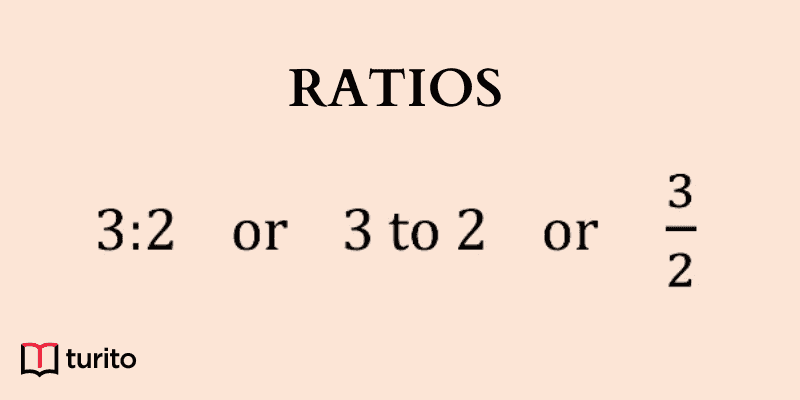
Representation of a ratio: There are three ways of representing a ratio.
- Using a colon – 2:3, 4:8, etc.
- Writing as a fraction – 23,23, 48 48 , etc.
- Writing to between the terms – 2 to 3, 4 to 8, etc.
Ratios
A ratio is a comparison between the quantities of two things.
Example: There are 3 triangles and 2 squares.

We can write the ratio as
5.3.1 Compare ratios to solve a problem
Example 1: In a school, the ratio of the number of boys to the number of girls of grade 5 is 2:5 and the ratio of boys to girls of grade 6 is 3:8. Find which grade has a greater number of boys for the same number of girls.
Solution:
Step 1: Write equivalent ratios table for the given ratio of boys to girls of both grades until the number of girls becomes equal.

Step 2: After making the number of girls equal, compare the corresponding values of boys from the table. Hence, we observe that number of boys in grade 5 is greater in comparison to grade 6. Therefore, grade 5 has a greater number of boys.
Example 2: The ratio of soy sauce to lime juice in a homemade salad dressing is 7:6. The ratio of soy sauce to lime juice in store-bought dressing is 11:9. Which dressing has the greater soy sauce to lime juice ratio?
Solution:
Step 1: Write equivalent ratios in a table for the given ratio of soy sauce to lime juice for both homemade and store-bought dressings until lime juice is equal.

Step 2: After making lime juice equal, compare the corresponding values of soy sauce from the table. Hence, we observe that soy sauce in homemade is greater in comparison to soy sauce of store-bought dressing. Therefore, homemade dressing has a greater soy sauce to lime juice ratio.
Introduction:
5.4 Represent and graph ratios
Graph is a collection of equivalent ratios that lies on a ray through the origin. The ratios are interpreted as ordered pairs, and the points associated with a ratio are plotted.

5.4.1 Explore ratios in tables and graphs
Example 1: Robert can drive 160 miles on 10 gallons of gasoline. How far can he drive if he has 20, 30 and 40 gallons of gasoline?
Solution: The ratio 10:160 represents the consumption of gasoline to mileage.
Step 1: Make a table of equivalent ratios to find the distance Robert can cover using 20, 30 and 40 gallons.

Step 2: The values in the table can be used to write the ordered pairs (10, 160), (20, 320), (30, 480),
and (40, 640).
Robert can go 160 miles on 10 gallons, 320 miles on 20 gallons, 480 miles on 30 gallons and 640 miles on 40 gallons.
Step 3: Plot the pair of values on the co-ordinate plane for each ratio, x to y. Connect the points and extend the line.

Example 2: Ms. Lopez sells muffins at her bakery. She sells them in packages. She sees that the ratio of packages to the number of muffins is maintained as 1:5. Find the number of packages she needs if the muffins are 10, 15, 20, 25, 30, 35 and 40.
Solution: The ratio 1:5 represents the packages to the number of muffins.
Step 1: Make a table of equivalent ratios to find how many packages are needed to pack 10, 15, 20, 25, 30, 35 and 40 muffins.

Step 2: The values in the table can be used to write the ordered pairs (1, 5), (2, 10), (3, 15), (4, 20), (5, 25), (6, 30), (7, 35) and (8, 40).
Ms. Lopez can pack 5 muffins in 1 package, 10 muffins in 2 packages, 15 muffins in 3 packages, 20 muffins in 4 packages, 25 muffins in 5 packages, 30 muffins in 6 packages, 35 muffins in 7 packages and 40 muffins in 8 packages.
Step 3: Plot the pair of values on the co-ordinate plane for each ratio, x to y. Connect the points and extend the line.

5.4.2 Graph ratios using repeated additions
Example 1: A designer is trying to decide on just the right shade of blue for a new line of jeans. He decides to mix 3 gallons of blue color with 2 gallons of white color. How many gallons of blue color does he need if 10 gallons of white color is to be used?
Solution:
Step 1: Use repeated addition to form a ratio table.
Step 2: For each row in the table, add 3 to the blue color and add 2 to the white color.
Step 3: The values in the table can be used to write the ordered pairs (3, 2), (6, 4), (9, 6), (12, 8 ) and (15, 10).
The designer mixes 3 gallons of blue with 2 gallons of white, 6 gallons of blue with 4 gallons of white, 9 gallons of blue with 6 gallons of white, 12 gallons of blue with 8 gallons of white, 15 gallons of blue with 10 gallons of white.
Step 4: Plot the pair of values on the co-ordinate plane for each ratio, x to y. Connect the points and extend the line.

5.4.3 Graph ratios related to pi
What is pi?
The ratio of the diameter of a circular object to the circumference of the circular object is defined
as pi.

Example 1: Draw a circular object with a diameter of 10 inches and a circumference of 50 inches. What will be the diameter if the circumference is 300 inches?
Step 1: Make a table of equivalent ratios to find the circumference, when the diameter is 10, 20, 30, 40, 50 and 60.

Step 3: The values in the table can be used to write the ordered pairs (10, 50), (20, 100), (30, 150), (40, 200), (50, 250) and (60, 300).
The diameter of 10 inches has a circumference of 50 inches. Similarly, the diameter of 50 inches has a circumference of 300 inches.
Step 4: Plot the pair of values on the co-ordinate plane for each ratio, x to y. Connect the points and extend the line.
Exercise:
1. To make plaster, Pelt mixes 3 cups of water with 4 pounds of plaster powder. How much water will pelt mix with 20 pounds of water?
2. James had 5 hits for every 8 bats. Clarke had 4 hits for every 7 bats. Who has the better hits to bats ratio?
3. A tank has a ratio of 3 guppies for every 5 angelfish. Find the number of angelfish in a tank with 15 guppies.
4. Radio station A broadcasts 2 minutes of news for every 20 minutes of music. Radio station B broadcasts 4 minutes of news for every 25 minutes of music. Which radio station broadcasts more news each hour?
5. Larry’s recipe calls for 3 cups of lemonade concentrate and 4 cups of water. Chris recipe calls for 3 cups of lemonade concentrate and 5 cups of water. Whose recipe makes stronger lemonade.

- Joe is shopping for supplies at Walmart If the cost of 2 apples is $3 and joe goes on to buy 4, 6, 8 and 10 apples. How many apples can he get for S24? Prepare a graph ratio.
- Cho is making juice. He has 25 strawberries, and he needs to add 3 apples for every strawberries. If Cho uses all the 25 strawberries, find the number of apples he needs.
- Prepare a graph ratio if an object having 3 inches diameter has 22 inches of circumference. What would be the circumference if the diameter is 18 inches?
- A student runs 7 minutes for every 10 minutes he walks. How long would the student walk if he runs for 21 minutes? Prepare a graph ratio..
- Abe can read 5 pages in 15 minutes. Anne can read 15 pages in 1 hour. How much longer would Anne take than to read 240 pages. Prepare a ratio graph or a table.
What have we learned:
• Understand how to compare ratios.
• Understand and compare ratios to solve a problem.
• Exploring ratios in tables and graphs.
• Graph ratios using repeated additions.
• Graph ratios related to pi.
Related topics

Square 1 to 20 : Chart, Table, Perfect Squares and Examples
Square 1 to 20 When you multiply a number by itself, the result is called a square. And when you’re preparing for exams, you need to have a foundation for algebra and quick mental math because you get a really short time to do your exam. Therefore, learning the squares from one to twenty is […]

Square 1 to 40 : Table, Perfect Squares, Chart and Examples
Square 1 to 40 When you multiply a number by itself, the resulting number is a square, and if you are someone who is either appearing in a competitive exam or just wants to do well in math in school, knowing square 1 to 40 is a really important skill. But manually multiplying every time, […]

Square Root : Definition, Formula, Methods and Types Explained
Square Root Square roots are one of those seemingly daunting maths topics that appear in many different situations, from algebra to geometry. Yet the concepts behind them aren’t as hard to grasp. It makes handling numbers far easier if you know the concept well. Let us understand how to find the square roots of a number […]

Cubes 1 to 20 : Chart, Table, Memory Tricks and Examples
Most students don’t struggle much with smaller cubes like 2³ or 3³. Those usually come quickly. The hesitation starts with numbers like 11³ or 17³. Or when someone suddenly asks, what is 20 cubed? That pause is not a memory problem. It’s about the lack of proper understanding and hence confidence. Naturally, learning cubes 1 […]


Other topics



Comments: