



Solving System of Equations by Substitution

Solving System of Equations by Substitution method is useful for solving a system of equations. It is most easily applicable to systems of linear equations. In this article, we will review the method of substitution. We will discuss what the substitution method is and how to solve system of equations by substitution. Also, we will solve multiple examples. It will aid in better understanding. So, let us begin the discussion.
What is the Solving System of Equations by Substitution?
It is the method of solving systems of linear equations by substitution. Substitution involves putting one equation into another as the substitute of a variable. We substitute one variable with its found value to solve the problem.
The Substitution Method is highly useful in topics including linear algebra, computer programming, and more. Notably, solving systems of equations by substitution method is very uncomplicated.
Before discussing how to solve the system of equations by substitution, let us crisply review the system of equations.
System of linear equations

It is a set of two or more linear equations.
Given two variables (x & y), the graph of a system of two linear equations is a pair of lines in the plane.
Here, We Have Three Possibilities:
- The lines are parallel. These will intersect at zero points.
- The lines intersect at a single point.
- The lines intersect at infinite points. It means two equations represent a similar line.
Systems of equations come as math problems, including two or more equations.
Solutions of System of Equations
Generally, a Solution of a System of Equations in Two Variables is an Ordered Pair. Such a Solution Makes both Equations True.
- The system having at least one solution is a Consistent solution
- The system having no solution is an Inconsistent solution.
- When all the solutions of one equation are the solutions of the other equation, the equations are dependent. (It means they both represent the same line.)
- Sometimes, the equations in a system do not share all solutions. Such equations of a system are independent.
Solving System of Equations by Substitution Method will have One of These Results:
(i) Only one value for each variable within the system, i.e., one solution
(ii) An untrue statement, i.e., no solutions
(iii) A true statement, i.e., infinite solutions
How to Solve System of Equations by Substitution
Consider the following equations:
y = 2x
x + y = 12
Here, the 1st equation shows that y is equal to 2x. This means we can put this value in place of y. So, let us put the value of y in the 2nd equation.
Putting such a value of y will make the entire equation involve one variable. When an equation has one variable, we can easily find its solution.
Substituting the value of y in 2nd equation,
x + 2x = 12
3x = 12
x = 12 / 3
x = 4
So, now we have a specific value for x. But don’t forget, you need the value of y. We have to find a specific value for y. For this, we will put the value of x into the 1st equation.
y = 2x
y = 2(4) (substituting 4 in place of x)
y = 8
So, in solving the system of equations by substitution, we got our solution.
The solution to the given system of equations is (4,8).
It is better if we check these solutions. For this, we have to put the solutions back into the system of equations.
1st equation: y = 2x
Putting the values,
8 = 2(4)
8 = 8
2nd equation: x + y = 12
Putting the values,
4 + 8 = 12
12 = 12
The above system of equations is a basic example. So you can easily understand the concept.
Let us move ahead.
Solving for a variable first before using the Substitution Method
Usually, as a High school student, you won’t get the value of x or y already equated. There will be no ready-to-use value for substitution. Rather, you will get the problem as a pair of linear equations to solve.
Consider a System of Equations:
3x + 4y = -5
2x – 3y = 8
Here, we can observe that none of the above equations is already solved. There is no value for either x or y available for substitution. So, we have to first solve for x or y. Then, we will do the substitution.
How to do this? Let us Discuss.
For solving systems of linear equations by substitution, we have to follow these steps:
Step 1: Select one equation from a pair of linear equations.
Step 2: Now, we have to solve it for any of its variables (say, either x or y).
Step 3: Substitute the variable’s value (solved in Step 2) in the other equation.
Step 4: Solve the second equation to find the value of the other variable.
Step 5: Check the solutions. We can do so by putting them into either of the original equations. Such an equation must involve both variables.
When we are solving systems of linear equations by substitution, typically, one equation and one of the variables pave the way for the solution more quickly than the other. To understand this well, let us solve some examples.
Solved Examples
Example 1
3x + 4y = -5
2x – 3y = 8
Now, we will try solving the system of equations by substitution.
Here, we will solve by selecting variable x and the second equation.
First, we will solve x for the 2nd equation.
2x – 3y = 8
2x = 3y + 8
x = 3y / 2 + 4 (3rd eq.)
Next, we will substitute the value of x, i.e., 3y / 2 + 4, in the 1st equation.
3x + 4y = -5
3(3y / 2 + 4) + 4y = -5
Now, we will solve this equation.
9y / 2 + 12 + 4y = -5
17y / 2 = -5 – 12
17y / 2 = -17
y = -2
Here, we will substitute the value of y into any equation that has both the variables x and y.
Substituting the value of y, i.e., y = -2, into the 3rd equation.
x = 3y / 2 + 4
x = 3(-2) / 2 + 4
x = -6 / 2 + 4
x = -3 + 4
x = 1
Also, students can check their solutions by putting the found values in both the original equations.
Putting the values of both variables x and y in the 1st equation.
3x + 4y = -5
3(1) + 4(-2) = -5
3-8 = -5
-5 = -5
2x – 3y = 8
2(1) – 3(-2) = 8
2 + 6 = 8
8 = 8
Both LHS and RHS are equal.
Hence, the solutions x = 1 and y = –2 are correct.
| A fact to consider: When solving systems of linear equations by substitution method, if the resultant solution is correct, it will be 0 = 0 (or LHS = RHS) on checking it. This shows that the system is dependent. Any of the original equations is a solution. However, if the substitution method results in an incorrect solution, it will not result in LHS = RHS (e.g. 0 = 4). This shows that the system is inconsistent. There is no solution for this system. |
Example 2
-7x – 2y = -13
x – 2y = 11
Like before, we will solve by selecting variable x and the second equation.
x = 11 + 2y
Now, we will put this value of x in the 1st equation.
-7x – 2y = -13
-7(11 + 2y) – 2y = -13
-77 – 14y – 2y = -13
-77 – 16y = -13
-16y = -13 + 77
-16y = 64
y = -4 (on dividing 64 by 12)
Now, we have to find x. For this, put the value of y in the 1st equation.
x = 11 + 2y
x = 11+ 2(-4)
x = 11 – 8
x = 3
Hence, the solution for this system of equations is (3, -4).
Checking the solutions:
-7x – 2y = -13
-7(3) – 2(-4) = -13
-21 + 8 = -13
-13 = -13
x = 11 + 2y
3 = 11 + 2(-4)
3 = 11 – 8
3 = 3
It proves that the values or solutions are correct.
Application-based Problem
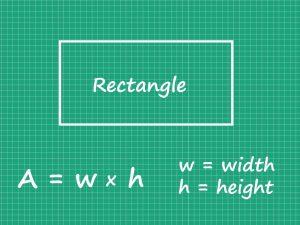
- The perimeter of a rectangle is 60 m. The length of this rectangle is 10 m longer than its breadth. Calculate the dimensions of the rectangle by the substitution method.
Let l be the length and b be the breadth.
Framing the above information into a system of equations:
2 (l + b) = 60
l = b + 10
(Here, we have variables l & b in place of x & y)
On Substituting the value of l in the 1st equation,
2 [(b + 10) + b] = 60
2 [2b + 10] = 60
4b + 20 = 60
4b = 60 – 20
4b = 40
b = 10 (on dividing 20 by 4)
Now, to find l:
Putting the value of b in the 2nd equation.
l = b + 10
l = 10 + 10
l = 20
Checking both solutions:
Substituting values in the 1st equation,
2 (l + b) = 60
2 (20 + 10) = 60
2 (30) = 60
60 = 60
Substituting values in the 2nd equation,
l = b + 10
20 = 10 + 10
20 = 20
This proves the solutions are correct.
Hence, the length of the rectangle is 20 m, and its breadth is 10 m.
Students can refer to the above examples to learn how to solve the system of equations by substitution for solving relevant math problems.
At A Glance
We can summarize the method of substitution in three steps:
- Solve any one equation for one of its variables.
- Put/Substitute the found value into the other equation and solve it.
- Put/Substitute the solution for one variable into the original equation to find the other variable.
Solving the system of equations by substitution method is an efficient way of solving algebraic and geometric problems.
Frequently Asked Questions
1. How do you solve equations with the substitution method?
Solving equation with the substitution method is a lot like solving equations with the addition and subtraction method, but it’s a little easier to understand. If you have an equation like 3x – 4 = 7 and you want to solve it using the substitution method, you just need to find two numbers that add up to 7 but are multiples of 3. In this case, those numbers are 2 and 4—so:
3x – 4 = 7
In our example above, we’re trying to solve for x, so we can plug these two numbers into our original equation and see what we get:
3x – 4 = 7
2 + 4 = 6 (which means that x = 6
2. How do I solve the system of equations?
The first thing to do is to write down the equations, and then separate them by variables.
Next, use algebraic techniques to solve for the unknown values.
After that, plug each value into each equation, and solve for the other unknown value.
3. How do you solve each system by substitution?
To solve a system of equations, you’ll want to substitute one equation for the other. To do this, you’ll need to know what variable you’re working with. Is it an unknown, or is it an already known number? If the variable is unknown, then you’ll want to substitute it for that variable. If the variable is already known, then you’ll want to substitute it for that variable and leave the other as is.
4. How do you solve the system using substitution?
The solution to a system of equations is the point where all of the lines intersect. In order to find that point, we need to solve for all of the variables. To solve for all of the variables, we substitute one variable into each of the equations.
5. How do use substitution when solving a system of equations?
In a system of equations, there are two or more variables.
To solve a system of equations, you need to get one variable to be equal to the other variable(s).
The easiest way to do this is by using substitution.
Substitution is when you replace one variable with another value.

Related topics

Square 1 to 20 : Chart, Table, Perfect Squares and Examples
Square 1 to 20 When you multiply a number by itself, the result is called a square. And when you’re preparing for exams, you need to have a foundation for algebra and quick mental math because you get a really short time to do your exam. Therefore, learning the squares from one to twenty is […]

Square 1 to 40 : Table, Perfect Squares, Chart and Examples
Square 1 to 40 When you multiply a number by itself, the resulting number is a square, and if you are someone who is either appearing in a competitive exam or just wants to do well in math in school, knowing square 1 to 40 is a really important skill. But manually multiplying every time, […]

Square Root : Definition, Formula, Methods and Types Explained
Square Root Square roots are one of those seemingly daunting maths topics that appear in many different situations, from algebra to geometry. Yet the concepts behind them aren’t as hard to grasp. It makes handling numbers far easier if you know the concept well. Let us understand how to find the square roots of a number […]

Cubes 1 to 20 : Chart, Table, Memory Tricks and Examples
Most students don’t struggle much with smaller cubes like 2³ or 3³. Those usually come quickly. The hesitation starts with numbers like 11³ or 17³. Or when someone suddenly asks, what is 20 cubed? That pause is not a memory problem. It’s about the lack of proper understanding and hence confidence. Naturally, learning cubes 1 […]


Other topics



Comments: