



Surface Area of 3d Figures With Examples

Key Concepts
• What is rectangular prism and cylinder?
• Introduction to volume of a rectangular prism and cylinder
• Relation between the volume of a rectangular prism and cylinder
• Solving problems involving the volume of a cylinder
Finding Surface Area of Three-Dimensional Figures
Rectangular Prism:
- A rectangular prism is a prism with a rectangular base and faces corresponding to each side of a base.
- The faces which are not bases are called lateral faces

- In a rectangular prism the opposite faces are identical
- It has three dimensions ; Length, Breadth an Height
- A rectangular prism is also known as Cuboid
- Some examples of a rectangular prism in real life are books, boxes, buildings, bricks, boards, doors, containers, cabinets, mobiles, and laptops etc.,
- There are two types of Prisms
- Right Rectangular Prism
Its side faces perpendicular to each of its bases - Oblique rectangular Prism
Its side faces are parallelograms.

Cylinder:
A cylinder is a three-dimensional shape consisting of two parallel circular bases, joined by a curved surface

Examples of cylindrical shape objects in real life are Toilet paper rolls, plastic cold drink cans, pipes etc.,

- The line joining the centers of two circular bases is called the axis of the cylinder.
- The distance between the two bases of the cylinder is called perpendicular distance and is represented as height, “h”
- The two circular bases have a distance from the center to the outer boundary which is known as the radius of the cylinder as is represented by “r”
- The cylinder is a combination of two circles and one rectangle

- There are two types of cylinders
- Right circular cylinder
The two circular ends are directly aligned - Oblique Cylinder
The circular ends are not directly aligned

How Prism and cylinder are related?
A prism is a solid with bases that are polygons and the sides are flat surfaces. Let us consider a prism with regular polygons as bases. When we increase the number of sides, the Prism looks like a cylinder

What is Surface area of a solid?
Surface area is the “Sum of the areas of all faces or surfaces of a 3-dimensional figure” It is of two types
- Total surface area:
The sum of the areas of all of the faces or surfaces that enclose the solid (or) the area of all the faces including the top and bottom
- Lateral surface area:
The sum of the areas of all the faces of surfaces of the solid without the bases.
Surface area of a prism and cylinder:

The surface area of a cylinder can be found by breaking it down into three parts
- The two circles that make up the ends of the cylinder.
- The side of the cylinder, which when “unrolled” is a rectangle
We know that the cylinder is a combination of two circles and a rectangle
Hence, area of each circle with radius ‘r’ is
πr2
∴
Area of two circles =
2πr2
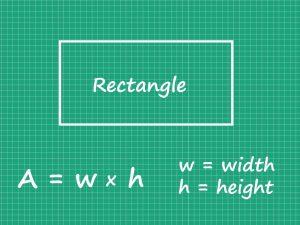
The area of the rectangle is width time’s height
Here, the width of the rectangle is nothing but the height of the cylinder ‘h’ and the length is the distance around the base circles ,that is circumference of the base circles ‘
2πr
’
∴
Area of the rectangle =
2πrh
∴
Surface area of cylinder = Area of two circles + area of the rectangle
=
2πr2
+
2πrh
=
2πr(h+r)
It is the same in case of right Prisms, A prism has each base a polygon and lateral faces are rectangles
Hence,
Surface area of a rectangular prism =
2×area of bases+sum of the areas of lateral suraces
If the prism is regular, the bases are regular polygons. And so the perimeter is ‘ns’ where ‘s’ is the side length and ‘n’ is the number of sides.
urface area =
2b+nsh2b+nsh
Where:
b= area of a base
n= number of sides of a base
s= length of sides of a base
h= height of the prism
For example, if the prism is a rectangular Prism, then

Surface Area =
2lw+2wh+2lh2lw+2wh+2lh
=
2lw+2h(l+w)2lw+2h(l+w)
=
2 lw+h×2(l+w)2 lw+h×2(l+w)
(Underline 2(l+w) in the above statement and draw an arrow mark and write perimeter of
Rectangular surface)
=
2lw+h.p2lw+h.p
Examples:
- Find the total surface area of a cylinder whose radius is 7 cm and height is 5cm.
Solution:
Given: Radius of the cylinder = r = 7 cm
Height of the cylinder = h = 5 cm
To find: Total surface area of the cylinder
By formula
TSA of the cylinder =
2πr(h+r)2𝜋r(h+r)
Substitute r = 7 cm and h = 5 cm in the formula
2×227×7(5+7)2×227×7(5+7)
( Show the cancellation of 7 in this equation)
2×22×122×22×12
528 sq.cm
∴∴
Total surface area of the cylinder = 528 sq.cm
- Find the diameter of the base of a cylinder if the surface area is 496𝜋 sq.cm and its height is 23 cm.
Solution:
Given:
Total surface area of a cylinder = 496𝜋
Height of the cylinder =h = 23cm
To find: Diameter of the cylinder (r)
We know by formula that TSA of a cylinder = =
2πr(h+r)2𝜋r(h+r)
=
2πr(h+r)=496π 2𝜋rh+r=496π
2πr(23+r)=496π sq.m2𝜋r23+r=496π sq.m
Bring
2π2𝜋
to the RHS
(Show that shifting by drawing an arrow mark from the top of
2π2𝜋
to RHS)
r(23+r)=496π×12πr23+r=496𝜋×12𝜋
r2+23r=248r2+23r=248
r2+23r−248=0 r2+23r−248=0
( Quadratic equation)
By soloving the equation using quadratic formulaBy soloving the equation using quadratic formula
r2+31r−8r−248=0 r2+31r−8r−248=0
r(r+31)−8(r+31)=0 rr+31−8(r+31)=0
(r+31)(r−8)=0 (r+31)(r−8)=0
r= −31 or 8r= −31 or 8
r=8 cmr=8 cm
∴Diameter=2×8 cm=16 cm∴Diameter=2×8 cm=16 cm
- The cost of painting a cylindrical container is Rs.0.04 per m2. Find the cost of painting 20 containers of radius 50 m, and height 80 m. ( Take π=3.14𝜋=3.14)
Solution:
Given: Radius of a cylindrical container = r = 50 m
Height of the container = h = 80m
Cost of painting the container = Rs 0.04 per sq.m
TO find: Total cost of painting 20 containers
To find the area to be painted, we need to find the TSA of the container
Using the formula
TSA of the cylindrical container =
2πr(h+r)2𝜋r(h+r)
Substitute r = 50 m ; h = 80m in the formula
TSA =
2×3.14×50(80+50)sq,m2×3.14×5080+50sq,m
=
100×3.14(130)sq.m100×3.14130sq.m
=
314×130=40,820 sq.m314×130=40,820 sq.m
Cost of painting the container per square meter = Rs.0.04
Cost of painting the container per 40,820 sq.m =
40,820×0.04=Rs.1632.8040,820×0.04=Rs.1632.80
Exercise:
1. Determine the height of a cylinder given that its total surface area is 1256 cm2 and its radius equals its height.
2. The height of a cylinder is equal to its base radius, and the surface area is 72π cm2.Find the height of the cylinder.
3. Find the lateral surface area of a cylinder with a base radius of 33 inches and a height of 99 inches. 4. The lateral area of a cylinder is 94.2 sq.in . The height is 6 in. What is the radius?
5. A cosmetics company that makes small cylindrical bars of soap wraps the bars in plastic prior to shipping. Find the surface area of a bar of soap if the diameter is 5 cm and the height is 2 cm. (Use 3.14 π)
Related topics

Square 1 to 20 : Chart, Table, Perfect Squares and Examples
Square 1 to 20 When you multiply a number by itself, the result is called a square. And when you’re preparing for exams, you need to have a foundation for algebra and quick mental math because you get a really short time to do your exam. Therefore, learning the squares from one to twenty is […]

Square 1 to 40 : Table, Perfect Squares, Chart and Examples
Square 1 to 40 When you multiply a number by itself, the resulting number is a square, and if you are someone who is either appearing in a competitive exam or just wants to do well in math in school, knowing square 1 to 40 is a really important skill. But manually multiplying every time, […]

Square Root : Definition, Formula, Methods and Types Explained
Square Root Square roots are one of those seemingly daunting maths topics that appear in many different situations, from algebra to geometry. Yet the concepts behind them aren’t as hard to grasp. It makes handling numbers far easier if you know the concept well. Let us understand how to find the square roots of a number […]

Cubes 1 to 20 : Chart, Table, Memory Tricks and Examples
Most students don’t struggle much with smaller cubes like 2³ or 3³. Those usually come quickly. The hesitation starts with numbers like 11³ or 17³. Or when someone suddenly asks, what is 20 cubed? That pause is not a memory problem. It’s about the lack of proper understanding and hence confidence. Naturally, learning cubes 1 […]


Other topics



Comments: