



Trapezium – definition, formula, properties, and examples

Trapezium is a polygon in geometry, it is not commonly mentioned in daily life. Nevertheless, there are various examples that one can see in real life. The following headings will deal with the definition, formula, properties, and examples of a trapezium.
What is a Trapezium?
Just like any other geometric shape, a trapezium is a polygon that comes under the category of quadrilaterals.
To understand a trapezium, one should also know what makes it a quadrilateral. A trapezium is a quadrilateral because it has four sides that join each other at four different angles and has four vertices. Hence, all the characteristics of a quadrilateral are displayed by a trapezium.
A trapezium is different from a square or a rectangle because it has only one pair of parallel lines. It means out of the four sides of a trapezium, only two opposite sides run parallel to each other.
In a trapezium, the parallel sides are known as bases, while the non-parallel sides are called the legs of a trapezium. A trapezium is sometimes also referred to as a trapezoid. However, these two figures are not the same. Keep reading to know this later in the article.

Definition of a Trapezium
The definition of a trapezium is very simple. A trapezium is a four-sided flat shape. It has one pair of opposite sides that are parallel to each other.
So, a trapezium:
- Has 4 sides
- Has 4 corners
- Has one pair of parallel sides
Shape of a Trapezium
The shape of trapezium looks like a small table top.
It is:
- A closed, flat shape
- Made with four straight lines
Two sides are parallel. Two sides are slanting or not parallel.
If you look at a trapezium shape image, you will see:
- One shorter side
- One longer side
- Two sides join them

What is the Shape of a Trapezium?
Like other 2D figures, the trapezium is also a two-dimensional structure. To begin with, a trapezium is made of four straight lines that join each other, making four different angles. However, while both squares and rectangles have two pairs of parallel lines, a trapezium only has one pair of parallel lines running opposite each other.
Like most polygons, a trapezium has a closed structure with four sides and four corners. The figure is characterized by having two lines that are opposite and parallel to each other. One can imagine this shape to be like a table with a surface that is shaped like a trapezium.
Trapezium Sides and Parallel Sides
Let us clearly understand trapezium sides and the idea of parallel sides.
In a trapezium:
- The two parallel sides are called bases
- The two non-parallel sides are called legs
So, trapezium sides include:
- Base 1
- Base 2
- Leg 1
- Leg 2
Note: Only the two bases are parallel sides. The two legs are not parallel to each other.

What are the Properties of Trapezium?
As mentioned above, a trapezium is a quadrilateral and possesses all the characteristics and properties the same.
It means trapezium shares the properties of every quadrilateral that makes it identifiable and different from other shapes. As a learner, one might understand more about the geometry and properties of the shape by understanding the properties of quadrilaterals.
The properties and characteristics of a trapezium concerning its shape are mentioned below:
- A trapezium is a two-dimensional shape
- One pair of opposite sides of a trapezium are parallel to each other
- These parallel lines are known as bases
- One pair of opposite sides in a trapezium is non-parallel to each other
- These non-parallel sides are known as the legs of a trapezium
- The length of diagonals in a trapezium is equal
- In a trapezium, both the diagonal intersect each other
- The adjacent interior angles of a trapezium make a sum of 180°
- In a trapezium, the sum of all the interior angles is always 360°
Angles of a Trapezium
A trapezium has four angles. When it comes to the angles of trapezium, you must know that:
- The total sum of all angles is 360°
- The two angles on the same side add up to 180°
This happens because one pair of sides is parallel and the sum of co-interior angles between two parallel lines is always 180°.
For example: If one angle is 110°, the angle next to it on the same leg will be:
180° – 110° = 70°
Diagonals of a Trapezium
The diagonals of a trapezium are lines that join opposite ends.
A trapezium has:
- Two diagonals
What you need to know about the diagonals:
- They cross each other inside the shape
- Do not always cut each other into equal parts
- Are not always equal in length
Only in some special trapeziums (isosceles trapezium) are they equal.
What is the Formula for Trapezium?
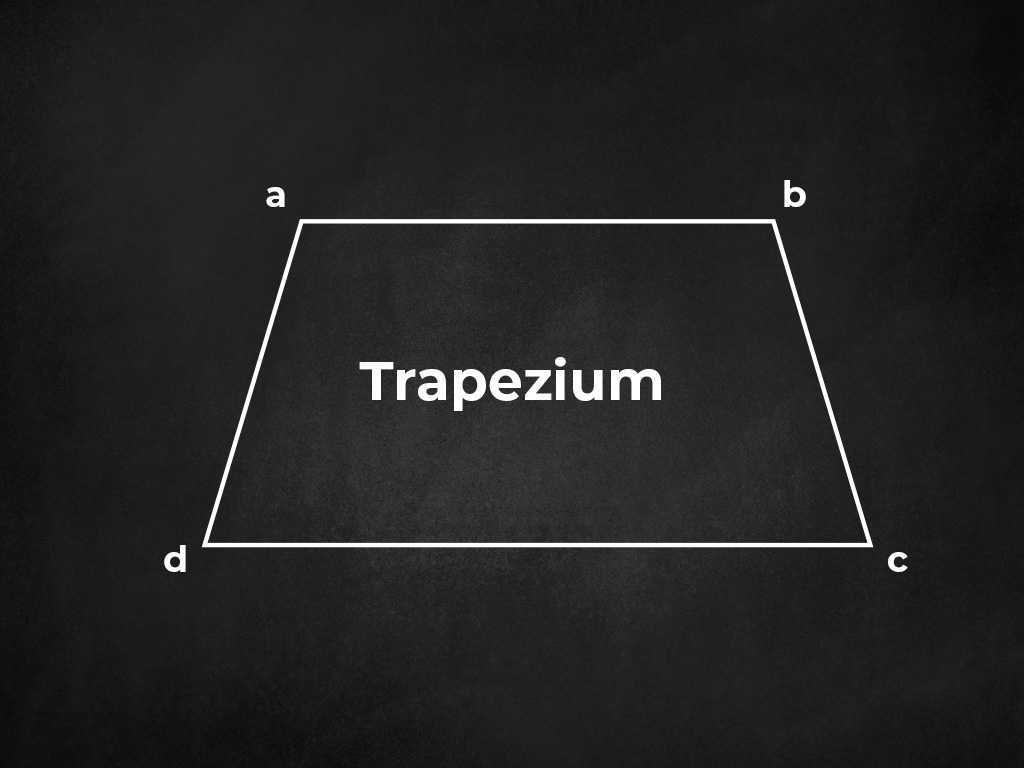
The trapezium is different from the regular shapes that one sees around them. To understand the different formulas of a trapezium, one should know its form. Below is a trapezium.
After understanding the shape of a trapezium, it will be easy for a person to understand the formula needed for the area and perimeter of a trapezium.
The area of a trapezium is given by,
Area of a trapezium = the average of bases × the height of the trapezium
Area of a trapezium = [(AB + DC)/2] × h
Here,
AB = length of base a
DC = length of base b
h = height of the trapezium
For a trapezium, the perimeter is the total length of the boundary covered by all four sides of the figure. Therefore, sides AB + BC + CD + DA = perimeter of a trapezium.
Area of a Trapezium Formula
The area of a trapezium formula is:
- Area = ½ × (sum of parallel sides) × height
In simple words:
- Add both parallel sides
- Multiply by height
- Divide by 2
It is similar to the area of a trapezoid formula.
Let’s take up an example to understand how to calculate area of trapezium:
- a = first base
- b = second base
- h = height
Then,
- Area = ½ × (a + b) × h
Example:
Suppose:
- Base 1 = 4 cm
- Base 2 = 6 cm
- Height = 5 cm
Using the trapezium formula:
- Area = ½ × (4 + 6) × 5
- Area = ½ × 10 × 5
- Area = 5 × 5
- Area = 25 cm²
Perimeter of a Trapezium
The perimeter of trapezium means the total length of all sides.
- Perimeter: Sum of all four sides
If the sides are: a, b, c, d
Then:
- Perimeter = a + b + c + d
What are the Different Types of Trapezium?
Depending upon the different features and properties of a trapezium, they are divided into three main types. The three main types of trapeziums are:
- Isosceles trapezium
- Scalene trapezium
- Right trapezium
Even though there are three different types of trapeziums, they share the same properties as trapezium. It means the above types of different trapeziums also have one pair of opposite sides parallel to each other. Apart from this, these structures are also two-dimensional figures.
Difference Between Trapezium and Trapezoid
| A trapezium is a quadrilateral with no parallel sides. | In Euclidean geometry, a trapezoid is always a convex quadrilateral. |
| The two parallel sides are called the bases. | A trapezoid is a four-sided closed two-dimensional shape with an area and a perimeter. |
| A Trapezium is a convex quadrilateral with at least one pair of parallel sides. | A quadrilateral with two parallel sides is known as a trapezoid. |
Define the Different Types of Trapezium
There are three main types of trapeziums based on their unique characteristics. However, these trapeziums differ from each other in having different measurements of their sides and their angles. The definition and characteristics of each type of trapezium are given below:
Isosceles Trapezium
In a trapezium, the non-parallel sides are known as legs. If the legs of a trapezium are of equal length, then it is known as an isosceles trapezium.
Scalene Trapezium
A trapezium is a quadrilateral. It means it has four sides that make up for different angles. However, in a scalene trapezium, the length and angles of all four sides are not the same. Hence, it is known as scalene trapezium.
Right trapezium
A right angle is equal to 90°. So, in a right trapezium, at least two sides make two right angles adjacent to each other. Therefore, it is a right trapezium.
What is Meant by the Perimeter of a Trapezium?
It is understood that the perimeter of a figure is the length of the total boundary covered by that figure. In this case, the perimeter of a trapezium is the entire length of all four sides that makes a trapezium.
To calculate the perimeter of a trapezium, one should know the length of all four sides of a trapezium. After knowing the four sides’ measurements, one can add these values to calculate the perimeter.
For example, if the four sides of a trapezium are – 2cm, 3cm, 5cm, and 3cm. Then, its perimeter will be –
Perimeter of the trapezium = 2 + 3+ 5 + 3 = 13 cm
How to Calculate and Find the Area of a Trapezium?
Area of a trapezium = average of the sum of both the parallel sides × distance between the parallel sides
The area is defined as the total space enclosed by a structure. So, the area of the trapezium is referred to as the total space covered by all four sides of a trapezium.
For example, the length of both the parallel sides of a trapezium is – 3 cm and 5 cm. And the distance between them is – 3cm, then the area is given by,
Area of a trapezium = [(3 + 5)/2] × 3
Area = [8/2] × 3
Area = 4 × 3
Area of a trapezium = 12 cm²
How is a Trapezium Different from a Trapezoid?
Even though a trapezium is referred to as a trapezoid in many instances, they are not the same.
It is important to know that a trapezium is a quadrilateral figure to simplify the confusion. Meaning it has four sides that make up four different angles. Apart from this, it is a two-dimensional structure with a single pair of parallel sides placed opposite each other.
On the other hand, there are no pairs of parallel lines in a trapezoid. It means all the four sides of a trapezium are non-parallel to each other.
What is an Irregular Trapezium?
In a regular trapezium, there is one pair of parallel lines opposite each other. However, in an irregular trapezium, there are no parallel sides. It means all the four sides are non-parallel to each other.
An irregular trapezium also does not satisfy the properties of a trapezium. Even though it is also a quadrilateral, it does not have a pair of two opposite parallel lines.
Can the Diagonals of a Trapezium Bisect Each Other?
It is a common misconception that both the diagonals of a trapezium bisect each other. However, it is not true.
The answer is that the diagonals of a trapezium do not bisect each other. Moreover, only the diagonal of a parallelogram bisect each other. It concludes that not every trapezium is a parallelogram. However, every parallelogram is a trapezium.
Conclusion
The above information explains the various concepts and areas regarding a trapezium. The formulas, definitions, examples, and other concepts of a trapezium are thoroughly described. Not just this, a description of different types of trapezium is also given. Knowing the different properties of trapezium can help a person apply them to various other concepts of geometry and mathematics.
Frequently Asked Questions
Is trapezium a parallelogram?
No. A trapezium is not a parallelogram. A parallelogram has two pairs of parallel sides. A trapezium has only one pair of parallel sides.
Is trapezium a quadrilateral?
Yes. A trapezium is a quadrilateral. A trapezium has four sides and four angles.
What is the sum of interior angles of a trapezium?
The sum of all interior angles of a trapezium is 360°. This is because a trapezium is a quadrilateral.
How do you describe a trapezium?
A trapezium is a quadrilateral with two pairs of parallel sides. The parallel sides are called “legs” and the other two sides are called “base.”
What are the differences between a trapezium and a rhombus?
A trapezium is a quadrilateral with no parallel sides. It has two pairs of parallel sides and at least one pair of opposite sides that are not parallel. A rhombus is a quadrilateral with four congruent sides. A rhombus also has two pairs of equal adjacent angles and two pairs of equal opposite angles.
Related topics

Square 1 to 20 : Chart, Table, Perfect Squares and Examples
Square 1 to 20 When you multiply a number by itself, the result is called a square. And when you’re preparing for exams, you need to have a foundation for algebra and quick mental math because you get a really short time to do your exam. Therefore, learning the squares from one to twenty is […]

Square 1 to 40 : Table, Perfect Squares, Chart and Examples
Square 1 to 40 When you multiply a number by itself, the resulting number is a square, and if you are someone who is either appearing in a competitive exam or just wants to do well in math in school, knowing square 1 to 40 is a really important skill. But manually multiplying every time, […]

Square Root : Definition, Formula, Methods and Types Explained
Square Root Square roots are one of those seemingly daunting maths topics that appear in many different situations, from algebra to geometry. Yet the concepts behind them aren’t as hard to grasp. It makes handling numbers far easier if you know the concept well. Let us understand how to find the square roots of a number […]

Cubes 1 to 20 : Chart, Table, Memory Tricks and Examples
Most students don’t struggle much with smaller cubes like 2³ or 3³. Those usually come quickly. The hesitation starts with numbers like 11³ or 17³. Or when someone suddenly asks, what is 20 cubed? That pause is not a memory problem. It’s about the lack of proper understanding and hence confidence. Naturally, learning cubes 1 […]


Other topics



Comments: