



Volume of Rectangular Prism – Formula, Definition, Examples

Volume is the total amount of 3-D space an object occupies. We measure volume in cubic units. So, if an object has a volume of 1800 cubic units, it means that it is made up of 1800 unit cubes. A prism is a polyhedron with identical bases, flat rectangular side faces, and the same cross-section. There are several prisms with varying shapes. In the article below, we will learn about the rectangular prism and the formula for the volume of a rectangular prism. Read on to discover how to find the volume of a rectangular prism.
Here is what we’ll cover:
- What is a rectangular prism?
- What is the volume of a rectangular prism?
- The formula for the volume of the rectangular prism
- How to find the volume of a rectangular prism?
- Solved examples of the volume of the rectangular prism
What is a Rectangular Prism?
A rectangular prism is a three-dimensional shape with six faces. All the faces of the prism are rectangles. A rectangular prism is cuboidal in form. This polyhedron has two pairs of congruent and parallel bases. It has six faces, 12 sides, and eight vertices. Some common names of rectangular prisms are rectangular hexahedron, rectangular parallelepiped, and right rectangular prism.
There are two main types of rectangular prisms – right rectangular prisms and oblique prisms.
A right rectangular prism has bases perpendicular to the other faces. This prism is in the shape of a geometric solid. It has a polygon as its base while the vertical sides are perpendicular to the base. The base and top of the rectangular right prism are of the same shape and size. It is called a “right rectangular” prism because it has right angles between the base and sides.

On the contrary, in an oblique, rectangular prism, the prism’s bases are not perpendicular to the other faces. In this case, the height of the rectangular prism is perpendicular drawn from the vertex of one base to the other base of the rectangular prism. However, we can use the same formula to calculate the volume of the rectangular prism, irrespective of the type of prism.
Properties of a Rectangular Prism
The properties of a rectangular prism are as follows:
- A rectangular prism has a rectangular cross-section.
- It has two pairs of congruent and parallel bases.
- A rectangular prism has a total of 6 faces, 12 sides, and eight vertices.
- Like a cuboid, it has three dimensions- the base width, the height, and the length.
- The top and base of the rectangular prism are rectangular.
- The pairs of opposite faces of a rectangular prism are identical or congruent.
- A right rectangular prism has rectangular lateral faces.
- An oblique rectangular prism has parallelograms as its lateral faces.
What is the Volume of a Rectangular prism?
The volume of a rectangular prism is defined as the total space occupied by the rectangular prism. We can obtain the volume of the rectangular prism by multiplying its length, breadth, and height just as we do for a cuboid. Therefore, the unit for the volume of a rectangular prism is cm3, m3, and so on.
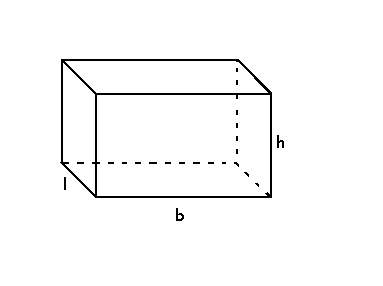
The Formula for the Volume of Rectangular Prism
The formula for calculating the volume of a rectangular prism is,
Volume = lbh
Where,
- “l” is the base width of the rectangular prism
- “b” is the base length of the rectangular prism
- “h” is the height of the rectangular prism
We can also write this formula as,
The volume of rectangular prism = base area × height of the prism
The base of a rectangular prism is a rectangle. So, the area will be l × w. When we multiply this area by the height of the prism, we get the volume of the rectangular prism.
How to Find The Volume of a Rectangular Prism?
To calculate the volume of the rectangular prism, we must first ensure that all the prism dimensions are of the same units. The following steps help estimate the volume of the rectangular prism.
Step 1: Identify the base of the rectangular prism and find its area using the formula.
Step 2: Next, we will identify the height of the prism. The height of the prism is perpendicular to the base of the prism.
Step 3: Now multiply the base area and the height of the rectangular prism to get the volume.
Applications of Rectangular Prism in Real-Life
There are numerous applications of rectangular prisms. We can find many at our homes. Some examples of rectangular prisms around us are:
- An aquarium
- A truck
- Cereal boxes
- Chest of drawers
- Cartons
- Rectangular tissue boxes
- Shirt boxes
- Trunks
- Tanks
- Sleeping mattresses
Solved Example of Volume of a Rectangular Prism
Example 1: Given the base length of a rectangular prism is 10 cm, the base width is 5 cm, and the height is 15 cm. Find the volume of a rectangular prism.
Solution:
Given,
b = 10 cm
l = 5 cm
h = 15 cm
Using the volume of a rectangular prism formula,
The volume of a rectangular prism= l bh
= 10 × 5 × 15
= 750 cm3
The volume of the rectangular prism is 750 cm3
Example 2: The volume of the rectangular prism is 1920 cm3, and the area of the base of the rectangular prism is 240 cm2. Find the height of the rectangular prism.
Solution:
Given,
Area = 240 cm2
Volume = 1920 cm3
Using the volume of a rectangular prism formula,
The volume of rectangular prism= l bh
1920 = 240 x h
h = 1920/240
The height of the rectangular prism is 8 cm.
Example 3: Given that the length of the rectangular prism is 10 m, the width is 2 m, and its volume is 40 m3. Find the height of the prism.
Solution:
Given,
L = 10 m
B = 2m
V = 40 m3
Using the volume of a rectangular prism formula,
The volume of rectangular prism= l bh
40 = 10 x 2 x h
h = 40/20
h = 2 m
The height of the rectangular prism is 2m.
Example 4: Find the volume of a rectangular prism if the area of the base of the rectangular prism is 160 cm2. Given the height of the rectangular prism is 25 cm.
Solution:
Given,
Area = 160 cm2
Height of the prism = 25 cm
Using the volume of a rectangular prism formula,
The volume of a rectangular prism= l bh
Volume = 160 x 25
Volume = 4000 cm3
The volume of the rectangular prism is 4000 cm3.
Example 5: Find the total volume of the combined rectangular prisms from the following figure

Solution: First we will find the volume of the lower step, using the volume of the rectangular prism formula,
The volume of rectangular prism= l bh
Volume = 7 x 6 x 1
Volume = 42 cm3
Now, we will calculate the volume of the broader step, using the same formula,
The volume of a rectangular prism= l bh
Volume = 7 x 3 x 4
Volume = 84 cm3
Now, adding both volumes, we will get the total volume of the combined rectangular prisms
Total volume = 84 + 42 cm3
Total volume = 126 cm3

Related topics

Square 1 to 20 : Chart, Table, Perfect Squares and Examples
Square 1 to 20 When you multiply a number by itself, the result is called a square. And when you’re preparing for exams, you need to have a foundation for algebra and quick mental math because you get a really short time to do your exam. Therefore, learning the squares from one to twenty is […]

Square 1 to 40 : Table, Perfect Squares, Chart and Examples
Square 1 to 40 When you multiply a number by itself, the resulting number is a square, and if you are someone who is either appearing in a competitive exam or just wants to do well in math in school, knowing square 1 to 40 is a really important skill. But manually multiplying every time, […]

Square Root : Definition, Formula, Methods and Types Explained
Square Root Square roots are one of those seemingly daunting maths topics that appear in many different situations, from algebra to geometry. Yet the concepts behind them aren’t as hard to grasp. It makes handling numbers far easier if you know the concept well. Let us understand how to find the square roots of a number […]

Cubes 1 to 20 : Chart, Table, Memory Tricks and Examples
Most students don’t struggle much with smaller cubes like 2³ or 3³. Those usually come quickly. The hesitation starts with numbers like 11³ or 17³. Or when someone suddenly asks, what is 20 cubed? That pause is not a memory problem. It’s about the lack of proper understanding and hence confidence. Naturally, learning cubes 1 […]


Other topics




Comments: